
Reviving European Inner Mobility: The Vision of the Starline Project
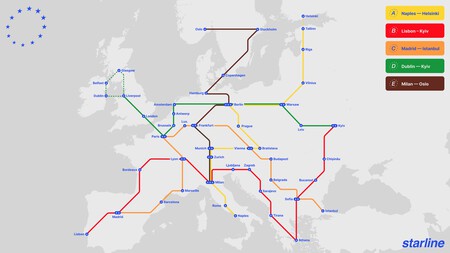
Historically, the train has served as the backbone of internal travel in Europe. With robust infrastructure, it enabled population movements for decades. However, the rise of low-cost flights has significantly shifted this dynamic. Yet, there is a growing momentum across Europe aimed at revitalizing rail travel . Initiatives like the NOX night train coalesce with innovative projects such as the Starline project —a high-speed ‘subway’ network designed to connect major European capitals. This ambitious plan embodies the core elements Europe seeks: interconnection, sustainable transport , and efficient goods transport. But is it truly feasible?
The Starline Project is spearheaded by a Danish group known as 21st Europe, which claims this initiative is not merely a luxury, but rather a strategic necessity for contemporary Europe. Envisioned as a high-speed rail network, Starline aims to link 39 key destinations across the continent with trains capable of reaching speeds up to 400 km/h —surpassing even the renowned TGV . The concept focuses on minimizing steep gradients and tight curves to maximize average speeds, thereby reducing travel times between cities.
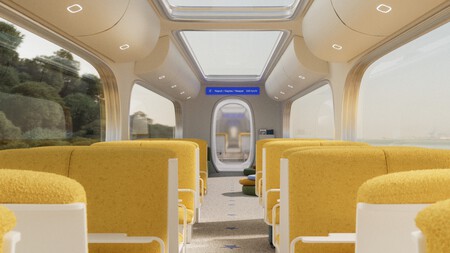
The intriguing notion of traversing from Madrid to Istanbul without disembarking or arriving in Helsinki via Vienna has captured public imagination. While achieving such high speeds poses challenges, the design incorporates spacious seating, quiet zones, dedicated areas for families, and even cafes—all fostering a comfortable travel experience. Furthermore, instead of the typical tiered seating arrangement found in airlines, the project aims for egalitarian seating. With an eye-catching blue design, the trains will stand out as iconic symbols of the network—akin to the red buses in London or the yellow New York taxis . Additionally, integrated real-time tracking systems would keep travelers abreast of their train’s status.
Transforming Stations into Cultural Hubs
The experience for passengers begins at the stations , which are envisioned not merely as transit points but as vibrant public spaces imbued with identity. The 21st Europe advocates for collaboration with renowned architects to transform stations into landmarks that reflect the culture of their regions. These buildings would not only facilitate transport but also offer spaces for shopping, dining, museums, and even sports venues, ensuring every trip could potentially culminate in an event like a concert or a match.
Shifting focus from human transport to goods, the project showcases the manifold benefits of rail. According to 21st Europe, rail transport is up to four times more efficient than conventional road transport in Europe. Surprisingly, only 18% of goods are currently moved by train. By tapping into high-speed rail for freight, the initiative aims to establish a new commercial network that operates more efficiently, reducing reliance on trucks, planes, and ships.
The Inspiration of China’s Rail Network
Much of the inspiration behind this project stems from China’s rapid expansion of its high-speed rail network . According to data shared by 21st Europe, cities connected to this network have seen their GDP rise by over 14% , while each new line contributes an additional 7.2% growth. Crucially, the strategy suggests placing stations outside crowded urban centers, thus avoiding traffic congestion while fostering economic growth in the surrounding areas.
Pursuing Sustainability
In a world increasingly focused on decarbonization , replacing short-haul flights with trains has garnered attention. Currently, the aviation sector represents around 4% of total greenhouse gas emissions in Europe, with flights producing five times more emissions per passenger-kilometer than trains. Proponents of Starline indicate that by leveraging renewable energy sources—such as solar and wind power—short flights could be effectively replaced by high-speed rail, theoretically reducing emissions by up to 95% .
Challenges Ahead
Despite its ambitious vision, the Starline project faces significant obstacles. The first challenge lies in the complex negotiations amongst governments and companies to provide a cohesive service. Funding is another critical hurdle, with the Danish group advocating for financial backing through EU infrastructure budgets and the European Bank for Long-term Investments . Each country’s government would need to co-fund regional stations while ensuring ticket prices remain competitive with low-cost flights.
Most concerning, however, is that 21st Europe currently operates as a think tank , generating visionary projects without the authority to implement them. Although the propositions may have monumental implications for future rail infrastructure, they remain as concepts rather than actionable plans. Whether someone will pick up this baton in the European Chamber remains uncertain, especially amidst the current focus on other priorities. Yet, the notion of a high-speed European subway resonates deeply, fueling imagined possibilities for a more interconnected and sustainable Europe.
Images | 21st Europe