
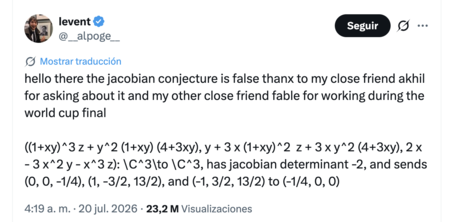
As Spain made history on Sunday by winning its second World Cup in soccer, a 34-year-old Harvard mathematician named Levent Alpöge asked Fable 5 for something interesting. Not that he tried to prove the Jacobi conjecture, but that he did the opposite: to refute it.
As Argentina kicked us while Spain played soccer, Ferrán of my life and my heart scored a historic goal. By the time it was all over, two things happened. The first, that Spain, we insist, was making history with its second star on the shirt. The second, that a conjecture that had not been proven for almost 90 years was definitively refuted thanks to the help of an AI.
The aforementioned Jacobi conjecture suggests that a certain type of mathematical function could also work in reverse. It was formulated by Ott-Heinrich Keller in 1939, and in 1998, the mathematician Stephen Smale included it in his famous list of unsolved mathematical problems that challenged mathematicians of the 21st century.
A Discovery that Leaves as Many Questions as Answers
Alpöge has not explained in detail how he managed to reach that result or what prompt he used. However, he indicated that part of the credit was due to his “close friend Fable“, the Anthropic model.
Abhishek Saha from Queen Mary University of London explained that the approach taken was unexpected. The conjecture seemed intuitively correct, but no one was attempting to refute it; their focus was primarily on proving it.
The Importance of Human Creativity in Mathematics
Chris Bowman-Scargill from the University of York pointed out a critical distinction: finding counterexamples that overturn conjectures is one thing, while constructing entire branches of mathematics is quite another—something that still requires human creativity. He cited Fermat’s Last Theorem, which was solved by Andrew Wiles in 1994, necessitating the development of dozens of pages with new and fascinating mathematical theories.
Several experts have validated this refutation, which was relatively straightforward to do. According to Saha, advances in AI had already surprised the mathematical community, but this was a significant leap: “This is probably the most important conjecture in which AI has had a relevant role so far in mathematics,” he stated.
The Role of AI in Mathematics
While several questions remain open, such as whether a version of the Jacobi conjecture with only two variables might still hold true, one thing is certain: mathematicians are increasingly leveraging AI tools in their work. The most celebrated names in mathematics are adopting these technologies to enhance their research capacities.
Ivan Fesenko from Westlake University in China discussed this trend, noting that “Right now, AI can already produce math graduates. In a year, it will produce math PhDs. And then the question arises: Do we really need that many mathematicians if AI can do these things so well?”
This question is indeed troubling, as it raises significant implications for the future of mathematics and the role of human mathematicians in a world increasingly assisted by artificial intelligence.
Image | Vitaly Gariev