
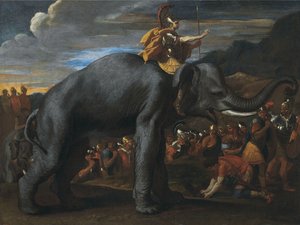
In southern Spain, archaeological excavations have proven that a troop of war elephants roamed Europe in the 3rd century BCE. Led by General Hannibal, the animals were integral to Carthage’s military campaign into Italy.
Significant Discovery in Cordoba
After six years of in-depth research at the Colina de los Quemados site in Cordoba, Spain, archaeologists have made a groundbreaking discovery: an elephant foot bone. This find supports historical accounts, suggesting that a troop of war elephants traversed Europe, particularly crossing the Alps under Hannibal’s command, as highlighted by a BBC report.
The findings have been published in the Journal of Archaeological Science and Reports, marking the first concrete evidence of elephants participating in military campaigns during Hannibal’s era.
A Closer Look at the Evidence
The 7-centimeter bone, classified as a “small compact bone of the front leg,” aligns with the size of an adult elephant’s carpal bone. Tests confirmed its approximate age to be 2,200 years, placing it between 215 and 205 BCE, a timeframe corresponding closely to the Second Punic War.
Hannibal’s Legendary Campaign
The Punic Wars were crucial conflicts fought between Rome and Carthage (modern-day Tunisia). The Second Punic War, notably, occurred from 218 to 203 BCE in Europe and subsequently from 203 to 201 BCE in Africa. Among its numerous highlights is Hannibal’s legendary crossing of the Alps, which has been celebrated by historians and artists alike.
Accounts suggest that Hannibal led a formidable force, including 37 elephants, across Spain and France to launch an invasion into Italy. This audacious maneuver has inspired various artistic representations, including Nicolas Poussin’s famous painting “Hannibal Crossing the Alps on the Back of an Elephant,” created between 1625 and 1626.
Implications of the Discovery
Although the exact species of the elephant corresponding to the excavated bone has yet to be identified, archaeologists believe this discovery represents the first known remnants of animals utilized in the Punic Wars for Mediterranean dominance. This finding not only elevates our understanding of Hannibal’s tactics but also sheds light on the military logistics of one of history’s most riveting campaigns.
As more research unfolds, the story of Hannibal and his elephants may reveal further layers, offering insights into the past while reshaping our comprehension of these ancient conflicts.