
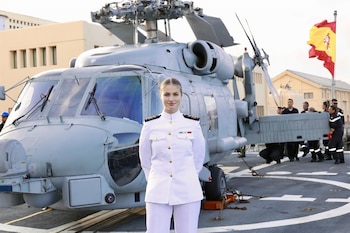
Princess Leonor’s New Chapter at the General Air Academy
Princess Leonor of Spain is set to embark on a remarkable journey as she joins the General Air Academy in San Javier, Murcia, on September 1. The young princess will immerse herself as a regular student, adhering to the stringent military protocols and facing a rigorous academic curriculum that encompasses extensive training in flight simulators before she gets the chance to pilot the Pilatus training aircraft alongside her instructors.
A Day in the Life of a Cadet
The day at the academy will commence at 6:30 AM with “Diana’s touch,” a tradition that signifies the start of daily activities. Following breakfast, classes will begin at 7:40 AM and continue until 3 PM, broken by a short recess. An additional session will run from 4 PM to 6 PM, after which students have designated free time until 10:15 PM. Dinner is scheduled for 8:30 PM, with a mandated curfew of silence enforced by 10:30 PM to promote discipline and concentration among the students.
This structured environment is not new to Princess Leonor; her previous experiences at the General Academy of the Army of Earth in Zaragoza and the Naval Military School in Marín, Pontevedra, have already familiarized her with military life. Now, she will advance her training as a fourth-year student, having attained the rank of Ensign.
The Challenge of Flight Training
One of the pivotal aspects of Princess Leonor’s experience this academic year will be her flight training. Colonel Luis González Asenjo, the director of the Academy, refrains from specifying when the princess might first take to the skies, noting the necessity of rigorous preparatory work. This includes comprehensive theoretical lessons followed by numerous simulator hours before she will even be permitted to pilot a plane.
Initial training occurs in a CBT simulator (Computer Based Training), which provides cadets with an introduction to flight instruments across three screens. The next phase involves honing skills in an FTD Advanced Simulator, which closely replicates the cockpit of the Pilatus aircraft and offers a 180-degree visual field for a near-realistic flying experience.
Advancements in Training Aircraft
Academy staff express their excitement about the newly-integrated training airplanes, which have replaced the C-101 aircraft, the long-standing model used for training over the past four decades. Colonel Asenjo emphasizes the high capabilities of the new simulators, allowing students to engage more confidently with the aircraft during their initial flights, thereby simplifying the learning curve.
Typically, simulator classes last between one to one and a half hours, during which instructors carefully cultivate emergency scenarios to prepare cadets for real-life, high-pressure situations in the air. This systematic approach significantly boosts a student’s confidence by familiarizing them with problem-solving in various conditions.
The Road to Solo Flight
Once the instructors feel the students are sufficiently prepared, they will reach a remarkable milestone: the first solo flight, colloquially referred to as being “loose.” While there is great anticipation around this moment, officials at the Academy will not comment on any timelines concerning Princess Leonor’s solo flight possibilities.
Throughout her military training, Princess Leonor has successfully adhered to all components stipulated by the Army and Navy curricula. Notably, her training included a six-month period on the School Ship ‘Juan Sebastián Elcano’, adding significant maritime experience to her profile.
However, the Air Force underscores the intricacies involved in piloting, reporting that some students, despite their extensive theoretical and practical training, have not yet been able to achieve solo piloting status.
Following in Distinguished Footsteps
As Princess Leonor progresses, parallels are drawn to her father, King Felipe VI, and her grandfather, Juan Carlos I, both of whom have experience in military aviation. Felipe VI notably piloted a Eurofighter, while King Juan Carlos flew an A400M, becoming the first head of state to do so.
Before taking to the skies, Ensign Bourbon must consider crucial physical requirements alongside carrying the complete pilot gear, which weighs around seven kilograms. Significant attention is placed on hydration, emphasizing that pilots must consume sufficient water before, during, and after flights.
The Academy ensures that students are constantly reminded of this hydration imperative, constructing visually striking signage in the simulator building that highlights how crucial it is for a pilot to remain hydrated based on flight weight and duration.
Life in Cadet Quarters
Starting from September 1, Princess Leonor will effectively be “one more student” at the Academy, as highlighted during a recent visit from Defense Minister Margarita Robles. She will share accommodations with three other female students in a dedicated dormitory exclusive to women. The facilities include shared bathrooms, shower areas, and individual spaces equipped with beds, desks, and storage for personal items.
The Academy provides basic supplies but recommends that students prepare ahead by packing essential items such as sun protection, mosquito repellent, and a basic first-aid kit.
As Princess Leonor embarks on this new chapter, she is not only fulfilling her military obligations but also setting a remarkable example of dedication and resilience for future generations. The journey she is undertaking at the General Air Academy is a testament to her commitment to her royal duties and personal development.