
In recent months, there has been growing concern about Spain’s environmental conditions. Rather than focusing solely on renewable energy, we must examine the impact of an unusually rainy spring and the subsequent effects of drought and heat waves, a recurring issue in the country. Today, paired with the ongoing threat of forest fires, Spain faces a complex environmental scenario. Despite these challenges, recent findings from NASA reveal that Andalusia , a key region in southern Spain, has become greener compared to the 1990s.
However, while the statistics may seem promising, a nuanced perspective is essential.
Microclimates and Mediterranean Forests. Spain hosts a variety of microclimates crucial for biodiversity, primarily in the Mediterranean region. This area, which makes up 26% of Andalusia, is characterized by its Mediterranean forests. The warmth and specific soil conditions have led to the dominance of species like pines and holm oaks . These species thrive particularly well in areas lacking substantial plant cover, indicating a unique adaptation to local environmental conditions.
Andalusia serves as a case study to better understand the concrete effects of climate change . With steadily increasing temperatures, decreased rainfall, and rising aridity observed over the years, researchers have been using satellite imagery to monitor vegetation health. A team from Ecological Indicators published findings that analyze how these forests have responded to climatic variations over the past three decades.
Analytical Tools. Researchers employed over 5,000 satellite images sourced from NASA’s Landsat program between 1994 and 2021 . They evaluated 2,358 plots , establishing a ‘greenery index’ supported by the Normalized Difference Vegetation Index (NDVI) . This index is essential for quantifying vegetation through remote sensing techniques, enabling researchers to assess the health and extent of flora in various regions.
NDVI serves as a marker, measuring living vegetation extent and vigor. This tool is widely utilized in studies relating to agriculture , natural resource management , and the effects of climate change.
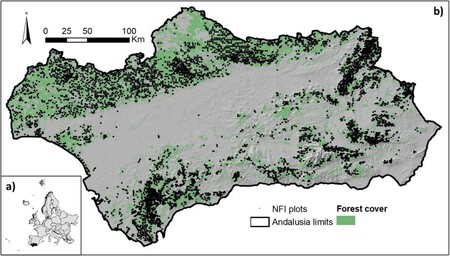
Black squares illustrate analyzed farms, revealing limited effects in agriculturally dependent areas.
Observations on Vegetation. Findings indicate that, other than the red eucalyptus , many species have exhibited a rise in their NDVI values, suggesting a trend toward increased vegetation. This is particularly true for holm oaks and pine trees, which show peak activity during milder winter months and reduced activity in the heat of summer. Conversely, chestnuts , the only deciduous species in the sample, display activity that peaks during warmer months.
Climate change conditions, including aridity , have a profound influence on vegetation cycles. For example, the Carrasco pine’s active growth period has expanded in drier regions, while moisture-dependent species have seen shorter activity periods. Between 1994 and 2005, there was significant growth across these species, though growth has slowed from 2005 to 2021.
The Causes Behind the Changes. The results indicate a more robust green territory , with many species showing resilience or even increased green coverage. Factors include the heat and drought tolerance of certain species, the natural reforestation practices, and global influences like heightened atmospheric CO₂, which may act as a natural fertilizer. Additionally, the abandonment of agriculture in some regions has permitted natural forest regeneration, while reduced livestock pressure has lessened damage to undergrowth.
However, practices that restrict regeneration, such as periodic cork extraction, do have negative consequences for some species like cork oaks.
Understanding Resilience. The study provides valuable insights into the state of the Mediterranean forests in Andalusia, focusing on resilient species that adapt effectively to fluctuating conditions, even in the face of rising average temperatures . The essential takeaway is that while resilience is evident, it doesn’t imply healthier vegetation overall. A myriad of natural and human factors influences regeneration, and growth is not uniform. The increasing dryness observed in southern regions hampers growth, emphasizing the need for strategic reforestation policies.
Reflecting on past climatic phenomena, such as that rainy spring, serves as a reminder of the pressing realities we face as summer approaches. Recent restrictions in regions like Galicia underline the ongoing struggle against drought and its consequences.
Image | José Sánchez Rodríguez and Rafael Palomo López
In summary, while advancements in vegetation health are noted, it is critical to approach these findings with caution. Ongoing monitoring and research will play essential roles in crafting effective environmental strategies moving forward.