
The Rise of DeepSeek in Challenging Markets
DeepSeek, a Chinese startup, burst onto the scene about a year ago, capturing attention with its significant market impact, even making waves on Wall Street. However, over the past twelve months, its prominence in public discussions has diminished, yet it continues to gain traction, particularly in areas where American technology faces challenges.
American Concerns Over DeepSeek’s Success
DeepSeek’s growing success poses a challenge for U.S. companies. Microsoft has raised alarms within the American tech community, highlighting the increasing pressure U.S. AI firms face from their Chinese counterparts. This is particularly evident in markets influenced by “open” models and competitive pricing strategies that DeepSeek employs.
The Strategy Behind DeepSeek’s Expansion
Accessibility over Aggressive Marketing. DeepSeek’s rise can be attributed more to its accessible offerings than traditional marketing efforts. According to Microsoft’s report, Global AI Adoption in 2025, the company has lowered barriers to entry by providing a free chatbot on both web and mobile platforms. This makes its services particularly appealing in cost-sensitive markets.
Revenue Model Despite Free Services
DeepSeek is not just about offering free services. The firm, founded by Liang Wenfeng, utilizes an open approach, distributing its technology under the MIT license and employing a unique licensing scheme for model weights. While the free chatbot generates interest, much of DeepSeek’s revenue comes from its API access, which allows developers and companies to integrate the models into their applications, capturing significant economic value.
The Adoption Landscape
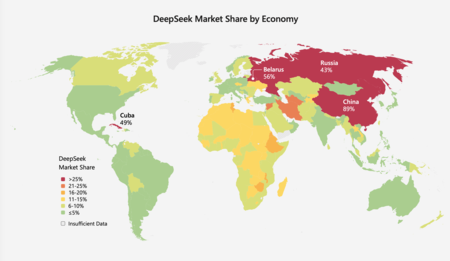
Emerging Markets Leading the Way. DeepSeek’s growth is not observed in traditional high-tech markets but rather in emerging economies and regions with limited American technological presence. Usage estimates indicate that DeepSeek holds approximately 18% market share in Ethiopia and 17% in Zimbabwe. In territories with restricted access to American technology, the numbers rise dramatically: 56% market share in Belarus, 49% in Cuba, and 43% in Russia.
Focusing on Africa’s Potential
Strategies for AI Deployment in Africa. Microsoft President Brad Smith has pointed out that while AI deployment in Africa is crucial, there are hurdles beyond just software. Many African nations require substantial investment in infrastructure, including data centers and subsidized electricity—a significant operational challenge. Smith cautions that relying solely on private capital will not suffice against companies like DeepSeek that often benefit from extensive Chinese subsidies.
The Future of DeepSeek and Its Impact
Evaluating Long-term Success. Despite DeepSeek’s softer presence in the media today, it continues to make waves in markets where American tech struggles to thrive. Its success is driven by its commitment to accessibility rather than merely corporate image. Observing developments in 2026 will be crucial: will DeepSeek maintain its competitive edge, and how will similar Chinese models leverage the same elements of openness, affordability, and domestic support?