
Tensions in Colombian Politics
Tensions between key presidential candidates in Colombia have intensified following the announcement of their respective vice-presidential picks. Paloma Valencia of the Democratic Center selected Juan Daniel Oviedo, former chief of the National Administrative Department of Statistics, as her running mate. This decision has stirred significant debate in Colombian politics and has led to varying responses from public figures.
The Context of the Announcement
Oviedo’s selection is notable not only due to his technical expertise but also due to his prominence as a member of the LGBT+ community. This choice has reignited discussions around the Democratic Center’s stance on the rights of sexual minorities, particularly in light of criticisms from figures like Claudia López, former mayor of Bogotá.
The Clash of Ideologies
López has criticized the Democratic Center’s historical positions on LGBT+ rights, notably highlighting their opposition to equal marriage and adoption rights. In response, Oviedo remarked that it is unreasonable for a member of the LGBT+ community to undermine the capabilities of others based on their political affiliations.
In a video response, López reiterated her condemnation of the party’s “anti-rights” agenda, emphasizing that significant changes could not be expected from them. This back-and-forth reflects broader ideological divisions within Colombian politics as the country gears up for the electoral battle slated for May 2026.
David Luna’s Defense of Oviedo
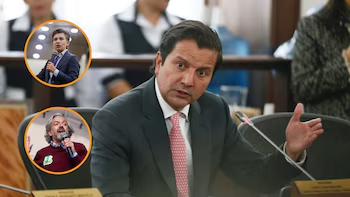
Former senator David Luna jumped into the fray, defending Oviedo’s choice to partner with Valencia. In a post on social media, he emphasized the importance of coherence in politics, arguing that collaboration among divergent groups is a sign of democratic maturity. Luna stated, “Deciding to build with those who think differently is not betrayal.”
He critiqued López’s perspective, suggesting that reducing political discourse to simple labels hinders progress and unity in Colombia. Luna’s comments resonate within the current polarized climate, where political alliances and ideological flexibility are often met with skepticism.
Social Media Reactions
The reactions on social media have been extensive, with some users accusing Oviedo and Valencia of compromising their principles for political gain. Critiques focus on the perceived contradictions between declared values and political practices. For instance, one commentator questioned whether the newly formed alliance genuinely represents a commitment to inclusivity or simply an opportunistic maneuver to secure government positions.
Conclusion
The ongoing discourse highlights the complexities that characterize Colombia’s political landscape. With divisive issues at the forefront, the choices made by candidates will have lasting implications on voter perceptions, especially concerning rights and representation. As the presidential election approaches, the significance of unity versus division remains a vital topic of conversation among Colombian citizens.