
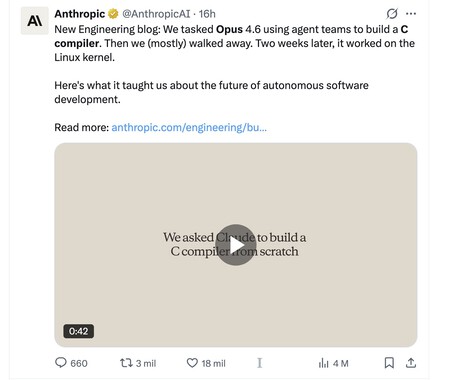
A New Era of Compiler Development: The Case of Claude Opus 4.6
We are facing a technological inflection point where software engineering, historically one of the most complex disciplines, is increasingly being transformed by AI. The recent achievement of Claude Opus 4.6 programming its own C compiler in just two weeks and for a mere $20,000 is nothing short of revolutionary.
What Has Happened
Nicholas Carlini, a researcher at Anthropic, shared insights into a groundbreaking development method called “agent teams.” This innovative approach enables multiple programming agents—specifically 16 in this case—to collaborate simultaneously using Claude Opus 4.6, resulting in the creation of a fully functional C code compiler.
Claude’s C Compiler (CCC)
Known as Claude’s C Compiler (CCC), this project consists of 100,000 lines of Rust code generated in just two weeks. Notably, Anthropic has made the source code available on GitHub. The compiler has already been tested successfully, compiling a functional Linux 6.9 kernel on platforms such as x86, ARM, and RISC-V.
Before: A Costly and Lengthy Process
This development illustrates a significant shift in how compilers can be created. Previously, it was typical for such projects to cost over two million dollars and take two years to complete. For example, the Microsoft Visual C++ compiler, requiring teams of 15 to 20 people over multiple years, exemplifies the resources that were once standard in compiler development.
Historical Investment in Compiler Development
Creating a C compiler from scratch has always been a demanding task, requiring deep knowledge of processor architecture. Companies like Cygnus Solutions invested over $250 million over a decade just to maintain and improve tools like GCC. Those days seem to be numbered.
Limitations and Future Potential
While Carlini noted that CCC has limitations—such as the lack of a 16-bit x86 compiler and no assembler or linker—the achievement marks a significant milestone in AI-led software development. Though still imperfect, it foreshadows a future where complex software projects can be tackled more efficiently.
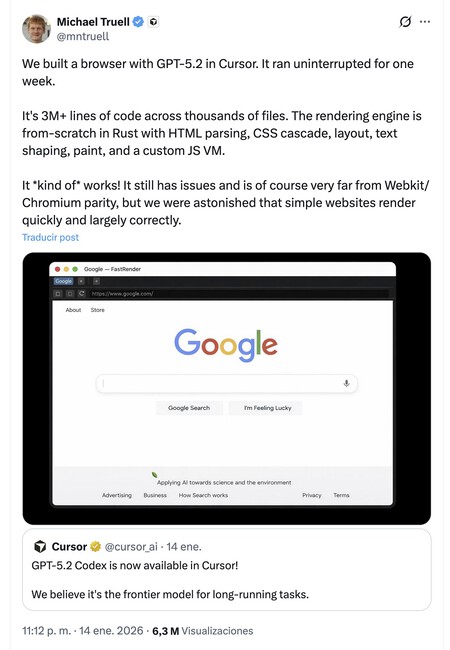
Cursor’s Similar Endeavor
Before the release of CCC, Cursor demonstrated another powerful AI-driven project by using GPT-5.2 agents to create a web browser in just one week. This resulted in three million lines of Rust code, showcasing the impressive capabilities of AI in development.
A Paradigm Shift for Anthropic
Experts from SemiAnalysis believe that Claude Code represents a paradigm shift in AI-assisted programming. Predictions for Anthropic in 2026 suggest the company may dramatically surpass current leaders like OpenAI.
Embracing AI in Programming
If you’ve tried using AI for coding tasks, you understand its potential. My own experience with tools like Immich shows that even tackling smaller projects is becoming easier and faster. As both OpenAI and Anthropic acknowledge, a portion of their latest model development has been done by the AI itself, leading to innovations that have real-world impacts.
Something significant is changing in the world of software development, and it’s worth keeping an eye on this evolving landscape.