
The CRASH Clock: A Warning Signal for Space Safety
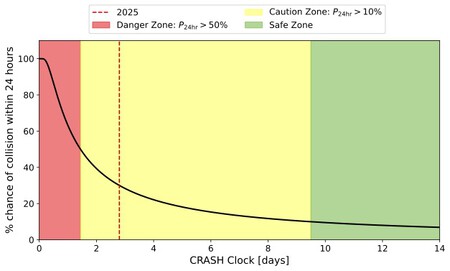
Low Earth orbit (LEO) is rapidly approaching a crisis point, with increasing satellite launches leading to a higher risk of catastrophic collisions. This alarming trend is encapsulated by the newly developed CRASH Clock (Collision and Significant Damage Watch), which currently indicates that we are just 2.8 days away from a serious collision should evasion maneuvering systems fail.
A Stark Contrast to 2018
In 2018, the situation appeared considerably safer, with the clock indicating 121 days until a potential collision, according to research led by Professor Sam Lawler from the University of Regina, Canada. This exponential decrease—from over four months of buffer to less than three days in just seven years—highlights the urgent need for improved management of LEO.
Why the Crisis Matters
The increasing density of objects in LEO, particularly from mega-constellations like SpaceX’s Starlink, significantly raises collision risks. Reports to the FCC indicate that these satellites execute an average of 44 evasion maneuvers per year, roughly one every 1.8 minutes. These frequent adjustments highlight a troubling reliance on technology to mitigate risks associated with higher object density.
In the most congested areas of LEO, satellites near Starlink experience approaches of less than a kilometer every 15 minutes. Given that these objects travel at speeds of seven kilometers per second, the potential for disaster is significant.
Dependency on Technology
While the current systems allow for some level of safety, the reliance on technology poses its own risks. SpaceX’s satellites engage in evasive maneuvers when collision probabilities exceed 3 in 10 million, far more conservative than the industry standard of 1 in 10,000. However, this over-reliance begs the question: what happens if these systems fail due to external pressures like a solar storm or software glitches? The study suggests we’re currently in the Caution Zone, with a greater than 10% chance of collisions occurring daily without evasive actions.
Insights from Research Simulations
Researchers utilized various analytical methods and simulations to assess collision risks, revealing that a hypothetical cessation of evasive maneuvers could lead to a collision within just three hours. With the frequency of close encounters increasing from once a day to over once every 15 minutes, the crunch for solutions becomes ever more pressing.
The Need for International Coordination
With multiple mega-constellations from various organizations poised to occupy the same orbital space, international communication is crucial. Questions arise about whether adversarial nations or secretive government satellites will engage in cooperative communication—a reality that could either mitigate or exacerbate collision risks.
Beyond Collisions: Additional Concerns
The implications of space congestion extend beyond collisions. Current issues include interruptions to astronomical observations and increased atmospheric pollution. Accordingly, the authors of the study urge immediate changes to how we approach LEO.
Looking Ahead
A dedicated website has been launched to provide ongoing updates on the CRASH Clock and to maintain awareness of the collision risks. The objective isn’t to incite panic but to foster situational awareness. In the short term, the risk of a major collision could resemble the Exxon Valdez disaster more than a dramatic, instantaneous catastrophe. The operational parameters will change, but the risk of collision damage will remain high if we don’t adapt.
Stay informed, stay prepared, and let’s advocate for safer practices in our increasingly crowded orbital landscapes.