
Unearthing History: The Christian Monastic Complex in Córdoba
Conducting construction works in a city like Córdoba is a risky endeavor . Spanish cities often reveal remnants of earlier eras during such projects. Iconic examples include the ruins beneath the Puerta del Sol and the archaeological site of Huerta de Otero in Mérida. However, Córdoba takes these discoveries to another level, as recent preventive excavations beneath the pathway of a significant new road have uncovered Christian ruins from the eighth century.
These are not just any artifacts; this discovery provides a unique context to the coexistence between Christians and Muslims during Córdoba’s Islamic period.
In Brief. The Ronda Norte of Córdoba is set to complete the city’s ring road. This complex project has been executed in phases and has been controversial due to resident complaints regarding noise from increased traffic. According to reports from El Debate, construction crews stumbled upon structures dating back to the 8th century , which will delay the road project further.
The date is significant as it sheds light on Córdoba during the initial decades of Islamic rule .
Layering History. Córdoba is a large city, but the Islamic Córdoba was even more extensive. Over the centuries, the city shrank due to new urban projects built atop ancient remains. The Mosque exemplifies this construction layering. Although overstated, it showcases how building occurred over what was once there.
Finding Islamic neighborhoods during excavations is not uncommon, but what makes this new discovery intriguing is the evidence of Christian worship . Due to the gradual Islamization of Córdoba, Christian practices were pushed to more peripheral areas.
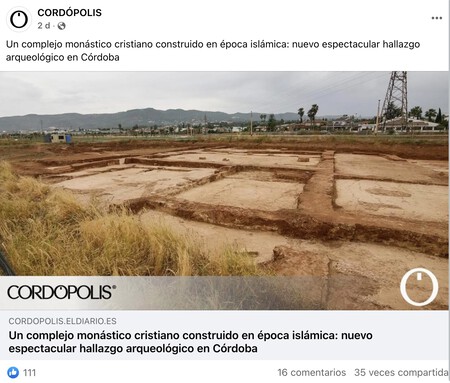
The Ruins. Alberto León, an archaeology professor at the University of Córdoba , indicates in Cordópolis that records once documented the destruction of Christian temples in the early hours of the 8th century . Subsequently, the “pact” of Abderramán allowed for spiritual coexistence between faiths. However, evidence of constructions by Mozarabs had yet to be discovered.
This is why the complex found beneath the future Ronda Norte is so significant. It features tapial walls (compact clay earth walls) and a 50-meter pool . Archaeologists have been examining the site since late last year, and they now propose that it was a monastic building , likely divided into areas for men and women, with columned cloisters surrounding a central patio. They believe the pool may have served as a baptistery .
The Lost Basilica. Ángel Ventura, a professor at the University of Córdoba , has hypothesized that these ruins might belong to a possible basilica honoring Saint Eulalia of Mérida . This martyr held immense significance in the city’s worship , and while documents suggest the existence of her basilica, it had never been located.
Crucial Insights. Ultimately, this discovery enriches the narrative of Christian-Muslim coexistence during this era. It’s significant because, according to Alberto León, it is one of two known examples of Christian worship structures existing within Islamic districts. Ongoing studies will provide deeper insights into its function, timeline, and abandonment, fostering hypotheses about interfaith coexistence in Córdoba.
Researchers are confident that many more such sites existed in the suburbs, prompting future excavations to offer even deeper context regarding the complex religious atmosphere of Islamic Córdoba . Moreover, it might necessitate delays or even a reconsideration of the road construction project to facilitate thorough study of this vital archaeological finding.
Image Sources: Toni Castillo Quero, Dolores Mª Macías Naranjo
In Xataka , similar urban dilemmas echo through many Spanish cities: balancing modern development with preserving cultural heritage.