
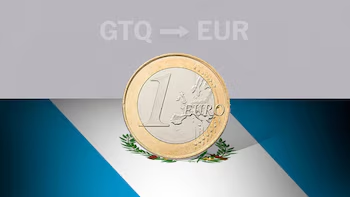
Closing Exchange Rate: Euro to Quetzal on November 17
The euro closed at an average value of 8.87 quetzales on November 17, reflecting a 0.39% decline from the previous day’s rate of 8.90 quetzales, according to Dow Jones.
Week-Long Performance and Annual Trends
Over the past week, the euro has seen a 2.39% increase in value, maintaining an impressive yearly growth of 14.66%. This recent drop in value has ended a five-day positive streak, showcasing the euro’s fluctuations.
Relative to last year, the current volatility levels are notably lower, indicating a more stable trading period. This trend suggests that the euro has recently experienced fewer unexpected variations compared to previous data.
Economic Forecasts and Challenges
Experts from the Bank of Guatemala have shared insights in their Macroeconomic Perspectives and Performance report, highlighting a mixed economic outlook leading into 2025. While a positive trajectory is anticipated, several potential challenges remain that could impact overall economic performance.
Globally, the International Monetary Fund (IMF) predicts positive economic growth spurred by robust labor markets in advanced economies, a revving services sector, and vibrant private consumption. This global expansion could create opportunities for Guatemala through enhanced foreign trade and investment.
Despite this potential, the IMF also cautions about significant risks that could derail growth, including persistent inflation in advanced economies and instability within major markets like China. Such factors could pose serious threats to Guatemala’s economy.
Influence of Trading Partners
Domestically, Guatemala’s economic growth is expected to correlate closely with the performance of its key trading partners, including the United States, Mexico, and the Euro Zone. As the U.S. is Guatemala’s foremost trading partner, its economic health will significantly influence local growth metrics.
The Quetzal: Guatemala’s Legal Tender
Introduced in 1924, the quetzal serves as Guatemala’s legal currency, designed to replace the outdated Guatemalan peso. Currently, it’s subdivided into 100 cents. Interestingly, the quetzal has maintained its stability over the years, with its value fixed around 7.50 to the U.S. dollar and 9.25 to the euro.
The Bank of Guatemala regulates currency issuance. Currently, coins in circulation include 5, 10, 25, and 50 cents, as well as various banknotes. In an effort to manage costs, the government has considered using alternative materials for coin production.
Economic Landscape and Societal Challenges
Despite stable growth over the last three decades compared to regional counterparts, Guatemala struggles with high rates of poverty and inequality. Alarmingly, it ranks as having the fourth-highest rate of chronic malnutrition globally, particularly affecting its rural and indigenous communities.