
Clavijo’s Concern Over Hantavirus Management in the Canary Islands
The Situation Overview
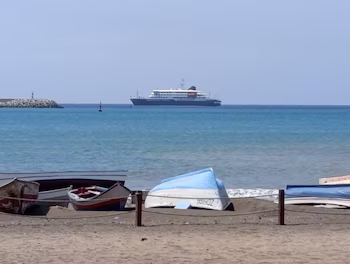
Fernando Clavijo, the president of the Canary Islands, has raised significant concerns regarding the handling of hantavirus cases linked to the MV Hondius cruise ship. He revealed that neither the Ministry of Health nor the central government has communicated effectively about the decision to dock the affected cruise ship in Tenerife, raising questions about the rationale behind such a protocol change.
Insufficient Resources for Critical Care
In an interview with TVE’s Mañaneros, Clavijo disclosed a troubling reality: his region’s health system has only one high-isolation bed available for treating highly isolated hantavirus patients. This limited resource could be problematic given the number of potential cases. While the Ministry of Health has emphasized that human-to-human transmission of hantavirus is unlikely, Clavijo’s apprehensions reflect a broader concern for public safety.
Urgent Meetings Demand
Clavijo has requested an urgent meeting with Spanish Prime Minister Pedro Sánchez to address what he perceives as an alarming lack of information about the situation. He criticized the government’s opacity regarding updates on the passengers affected, noting that last he heard, those infected were evacuated by medical plane from Cape Verde to Holland.
Government Response and Health Guidelines
In the early hours of Tuesday, the Spanish government announced that the Canary Islands would host the affected cruise ship at the request of the WHO, adhering to international law and humanitarian principles. Spain also agreed to facilitate the transfer of the ship’s doctor, who is reportedly in serious condition.
Yet, Clavijo remains skeptical. He articulated a genuine concern for the Canarian population, pointing out the uncertainty surrounding the health status of passengers and the exact number of infected individuals aboard. Currently, there are 14 Spanish citizens on the ship, alongside seven confirmed cases from different nationalities.
Political Implications
Clavijo illustrated his doubts about the motives behind the government’s decision, suggesting it may stem from a lack of technical justification. He firmly stated, “Before making a decision, we have to know what the situation is. If the agreement has been political, I don’t agree with it.” This sentiment was echoed by Rosa Dávila, president of the Cabildo of Tenerife, who criticized the unilateral decision made by the central government. She expressed a strong belief that actions could have and should have been taken in Cape Verde instead of transferring the ship to the islands.
Conclusion: The Need for Clear Communication
In these uncertain times, clear communication and collaborative strategies are crucial in addressing public health issues effectively. As Clavijo and other local leaders continue to demand transparency from the central government, the focus remains on ensuring the safety and well-being of the Canarian population amid growing concerns related to hantavirus.