
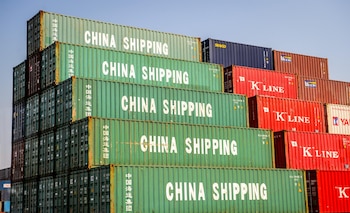
China’s June Exports Show Resilience Amid Global Challenges
In June 2025, China’s exports expanded to $325.18 billion (approximately €278.16 billion), marking a year-on-year increase of 5.8%. This rise is notable as it surpasses May’s growth of 4.8%, although it remains below April’s robust 8.1% increase and March’s impressive 12.4% growth, according to data released by the Chinese Customs Administration.
On the flip side, China’s total imports also saw a modest rise of 1.1% year-on-year, reaching $210.41 billion (around €179.99 billion). This improvement follows a period of decline, including a 3.4% contraction in May, reflecting the volatility in the global market.
Export Trends for the First Half of 2025
During the first six months of 2025, China’s exports amounted to $1.8 trillion (approximately €1.5 trillion), which is a 5.9% increase compared to the same period last year. Conversely, imports during this timeframe totaled $1.2 trillion (around €1 trillion), which represents a 3.9% decrease year-on-year. The mixed performance in trade mirrors the economic challenges faced by China and its trading partners.
Key Trading Partners
Among China’s key trading partners, exports to the European Union rose by 7.6% year-on-year in June, totaling $49.22 billion (around €42.10 billion). Imports from the EU also saw a 0.4% increase, amounting to $23.28 billion (approximately €19.92 billion). This favorable trend showcases the resilience of trade between China and Europe amidst fluctuating global economic conditions.
However, trade with the United States took a hit in June, with exports declining by 16.1% to $38.17 billion (about €32.65 billion). This follows a dramatic 34.5% fall in May and a 21% decrease in April. Imports from the U.S. also fell by 15%, totaling $11.60 billion (around €9.93 billion), in light of prior year-on-year declines of 18% and 13.8% in May and April, respectively.
Southeast Asia’s Growing Influence
In contrast, exports to the Southeast Asian Association of Nations (ASEAN), which includes countries like Vietnam, Malaysia, and Singapore, soared by 16.8% in June, reaching $58.19 billion (approximately €49.77 billion). This rise continues a positive trend with previous months showing increases of 19.8% in May and 20.8% in April.
Imports from ASEAN nations remained stable in June, with a reported total of $32.47 billion (approximately €27.78 billion) after a year-on-year decline of 5.3% in May. This resilient performance indicates the strengthening of China’s economic ties with its Southeast Asian neighbors.
Insights on Trade Resilience
Sophie Estramatt, a trade analyst, emphasizes that despite the challenges posed by the U.S. tariff policies, Chinese exports showed unexpected resilience. She noted that the data was more robust than anticipated, particularly highlighting an acceleration in export growth during June, driven partially by a less significant decrease in sales to the U.S.
Following the temporary tariff truce negotiated between the U.S. and China, there seems to be a front-loading of shipments before the agreed deadline in August. This strategic adjustment could have contributed to the recent uptick in exports, suggesting that businesses are positioning themselves to mitigate uncertainties in trade relations.
Rare Earth Exports on the Rise
One noteworthy segment of China’s exports is the rare earth sector, which saw sales surge to 7,742 tons, reflecting a staggering 32% increase from May and a remarkable 60.3% growth compared to June 2024. Over the first half of 2025, rare earth exports totaled 32,569 tons, which is 11.9% higher than during the same period in 2024.
In June, the U.S. and China reached an agreement for the accelerated handling of export requests for “controlled products,” including rare earths. Concurrently, the U.S. has indicated plans to ease several restrictive measures against China, particularly concerning technology related to microprocessor manufacturing, creating a more favorable environment for crucial resource exchange.
The latest trade data reflects a complex landscape where China’s exports are proving robust in several key markets, even as challenges persist in its trade relations with the U.S. The mixed signals from global trade dynamics underscore the importance of strategic adjustments in response to evolving economic conditions. As China continues to expand its influence in Southeast Asia and strengthen ties with the EU, the overall outlook for its trade performance remains cautiously optimistic.