
China has had one goal in mind for some years: to have a voice in the nuclear race. In weapons, yes, but also in energy. While Europe argues and the United States tries to rejuvenate its critical infrastructure to meet the needs of AI, China has been on the accelerator for months. Recently, not only have they approved 10 new reactors, but they are one step away from turning on a new generation nuclear power plant to provide ‘green’ energy for 1,000 years.
This is the CiADS system, or Throttle Actuated System. It is a type of reactor that China has been developing for more than 15 years and that promises to convert waste into energy. Their trick is to convert “garbage” into fuel, a very interesting twist for nuclear energy. And even more so in a China that wants to dominate the atom and renewables as a basis for developing another of the country’s great ambitions—artificial intelligence.
A Twist to Nuclear Energy
In a release, the Institute of Modern Physics of the Chinese Academy of Sciences provided details on how this accelerator-driven nuclear reactor operates. Uranium remains the fuel, but the term “reactor driven by an accelerator” is quite literal.
Using a particle accelerator, protons are “shot” at a heavy metal target at 0.8 times the speed of light. This collision generates neutrons that drive a reactor operating somewhat below the critical threshold to maintain a self-sustaining reaction. This mechanism generates energy, and the violent reactions lead to the transmutation of long-lived radioactive isotopes, typically produced in conventional nuclear power plants, into materials with shorter lifespans.
As highlighted by its developers in SCMP, the CiADS represents a hybrid between a nuclear reactor and a particle accelerator. The primary advantage of this method is that it significantly lowers the risk of uncontrolled reactions. Additionally, it allows for the reuse of radioisotopes that are commonly treated as nuclear waste to generate further energy.
By bombarding heavy metal with beams of protons, the uranium-238 transforms into a new nuclear fuel: plutonium-239. According to state-run media Science and Technology Daily, this is essentially turning waste into treasures.
Notably, this method is touted to be 100 times more efficient than conventional fission, converting nuclear energy into “a green, safe, and stable source of energy for 1,000 years.” The design also ensures that what would typically be long-lasting waste is reused more efficiently, leading to a useful life for the CiADS that is significantly shorter compared to conventional isotopes.
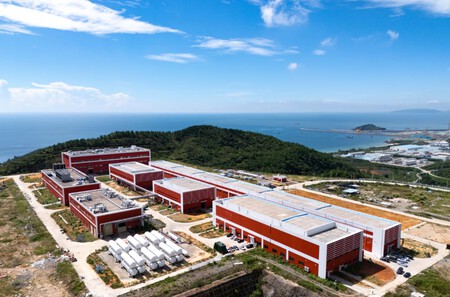
The CiADS under construction
China’s push into nuclear energy represents a dual strategy. While it is expanding its nuclear capacity, it reportedly lacks sufficient domestic uranium and remains dependent on imports, potentially even sourcing from beneath the seas. With “100 times more efficient” plants, higher yields can be extracted from available resources, diminishing the perceived dangers associated with nuclear waste.
If everything progresses as envisioned, China will have its first MW-scale CiADS operating by 2027. This will be the moment we can evaluate whether the ambitious claims made are borne out by real-world applications.
The inception of the CiADS comes at a pivotal moment for China, which has grappled with pollution while simultaneously investing in extensive renewable energy projects. Although it leads in clean energy infrastructure, the nation still heavily relies on coal and gas to feed its burgeoning technology sector and data centers.
Ultimately, while China might currently lag in semiconductor and AI technologies, its energy capacity places it in a favorable position. This investment in next-generation nuclear power, particularly innovations like nuclear fusion, lays the foundation for what lies ahead, provided the CiADS meets its ambitious expectations.
Images | Sahaza Delis, Tighef
In Xataka | There is a global race to be the first to reach nuclear fusion. And Germany just gave it an optimistic date.