

Let’s talk about five-year plans. Alexei Grigorievich Stakhanov had no idea that his exaggerated productivity would come back to haunt him. In 1927, he began working in the Tsentrálnaya-Írmino mine and discovered he was exceptionally skilled at his job. In fact, he performed much better than his colleagues. In August 1935, Stakhanov shattered records by extracting 102 tons of coal—an astonishing 14 times his quota—in just five hours and 45 minutes. Shortly after, he exceeded his own achievement by extracting 227 tons.
Stakhanov became a hero to socialist workers, even gracing the cover of Time magazine . This was the genesis of stakhanovism , which aimed to boost labor productivity based on individual initiative. However, this shift in focus didn’t concern Stalin, as the Soviet Union was deeply engrossed in its second five-year plan. The main objective was crystal clear: the frenzied industrialization of the country, with an emphasis on transforming all workers into new Stakhanovs. Consequently, the legacy of five-year plans continued into future iterations.
This notion of five-year plans found a new home in China , which began implementing them in 1953—thanks to assistance from the former Soviet Union—and has remarkably continued this practice to the present day. At this time, the Asian giant is currently debating its 15th Five-Year Plan , which emphasizes technological self-sufficiency .
The Central Committee of the Communist Party of China recently published a statement outlining their objective to “greatly increase” the self-dependence capacity of the nation. This plan includes several strategic focuses for the near future of China :
- Promote R&D in essential technologies like semiconductors, robotics, high-performance computing, and artificial intelligence .
- Establish a “modern industrial system” to reduce dependency on foreign components, equipment, and expertise.
- Reinforce the domestic market as a core pillar for growth, minimizing vulnerability from potential impacts of the export-oriented model.
- Align technological evolution with national security: self-sufficiency not only makes economic sense but also geopolitical sense.
This five-year plan emerges as a response to contemporary challenges, particularly influenced by the trade war with the United States . Both nations now aim to reduce their dependence on each other, marking a noticeable shift in global dynamics.

China’s new five-year plan clearly aims to establish a sustainable future, with implications for both the domestic landscape and global relations. It suggests greater state involvement in key industries and increased interventionism—a notable angle for countries like the U.S. On the flip side, this move may reduce Chinese demand for foreign technology, potentially exacerbating technological rivalry with the U.S. but perhaps presenting fresh opportunities for collaboration with other nations.
If successful, this five-year plan could stabilize China’s growth amidst external pressures. Conversely, if the focus on self-reliance becomes excessive, it may hinder international collaboration and competition, potentially stifiling innovation or resulting in less efficient enterprises.
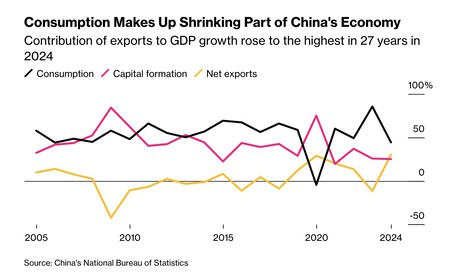
Source: Bloomberg
Additionally, as highlighted by Bloomberg , China is the world’s largest exporter, primarily due to its insufficient domestic consumption: it often produces more than it requires. Therefore, despite the increasing contribution of exports to the national GDP, consumption metrics have stagnated or decreased.
The full details of the final five-year plan are expected to be unveiled in March , with a heightened focus on the technological sector. This initiative, launched following the Trump administration’s initial veto of Huawei , seems to be yielding promising results, as China positions itself as a formidable force in technological innovation . There’s no indication that this momentum will slow down.
Alexei Grigorievich Stakhanov would likely be proud of how the legacy of accelerated productivity and ambitious goals lives on in modern frameworks.
Image | Chinese Communist Party
In Xataka | Spain has an antidote to mental and emotional exhaustion: the nap