
China’s Liquid Air Initiative: Stabilizing Solar Energy in the Gobi Desert
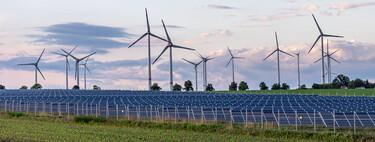
In the vast expanse of Qinghai province, where the Tibetan plateau converges with the Gobi desert, humanity has undertaken an ambitious project comprising 610 square kilometers of solar energy production. This “sea of silicon,” comparable in size to Madrid, houses seven million photovoltaic panels. These solar arrays not only generate energy but have also transformed the local ecology, providing shade that allows thousands of “photovoltaic sheep” to graze in an area where only sand existed before.
Overcoming Intermittency Challenges
Despite its monumental scale, this solar deployment faces logistical hurdles. As Wang Junjie, a researcher in the field, notes, solar and wind energy can be “random and intermittent.” When darkness blankets the Gobi desert, the stability of the power grid can falter. To address these challenges, China has decided to invest in liquid air energy storage (LAES) rather than conventional lithium-ion battery systems.
The World’s Largest Liquid Air Storage Project
Located on the outskirts of Golmud, a series of commanding white tanks signify the world’s largest liquid air energy storage project, affectionately dubbed the “Super Air Power Bank.” This facility, developed by the state-owned China Green Development Investment Group (CGDG), is nearing the final phases of commissioning. Boasting a remarkable capacity of 60,000 kilowatts (60 MW) and the ability to release up to 600,000 kWh per cycle, it can feasibly sustain the daily energy requirements of tens of thousands of homes.
Why Liquid Air? The Advantages Over Lithium
China’s preference for liquid air over lithium-ion batteries stems from its unique geographical and industrial context. While lithium is effective for smaller applications, such as mobile devices and electric vehicles, it encounters cost and degradation issues on an industrial scale. Conversely, liquid air is abundant and free; when converted to a liquid state, it becomes up to 750 times denser than its gaseous counterpart, enabling large-scale, efficient energy storage without relying on specialized geographical conditions.
The Cryogenic Alchemy: Turning Air into Energy
The LAES operation is a marvel of cryogenic engineering. The process unfolds in three critical phases:
Load (Compression): During daylight hours, excess solar energy from a nearby 250 MW plant powers massive compressors, which cool and purify the air to a frigid -194 degrees Celsius (-317°F), turning it into a liquid.
Heat Recovery: During compression, the heat generated is captured and stored in high-pressure tanks for reuse.
Discharge (Expansion): When electricity demand spikes or sunlight diminishes, the liquid air vaporizes, expanding 750 times. This explosive expansion drives a turbine to generate electricity, feeding back into the grid.
This entire cycle achieves over 95% cold storage efficiency and 55% round-trip efficiency, effectively utilizing what would otherwise be waste heat and eliminating the need for scarce materials.
A Global Laboratory on the “Roof of the World”
While other countries, such as the UK and South Korea, are developing similar facilities, China’s scale is unmatched. The success of the Qinghai projects is a testament to the country’s centralized approach, combining solar, wind, and hydroelectric resources.
At an altitude of 3,000 meters, the plateau’s cold, pure air enhances solar panel efficiency, with electricity produced being 40% cheaper than coal. This renewable energy not only powers homes but also fuels data centers that support China’s advancements in artificial intelligence.
From Factory to Engine of the World
As noted by Professor Ningrong Liu, China aims to transition from being merely the “factory of the world” to its “engine,” exporting engineering solutions and its innovative green energy model. The Golmud project symbolizes a profound paradox: the nation that emits the most CO2 also builds the most rapidly toward a sustainable future. Within the serene confines of the Gobi, amidst cryogenic tanks and grazing sheep, China is proving that the very air we breathe can be transformed into the fuel that will drive the 21st century.