
Half of the fish we eat is no longer caught in the open sea. Instead, it is raised in controlled facilities, often miles away from the coast. This practice is known as aquaculture , an industry that is rapidly expanding and now produces more fish for human consumption than traditional fishing, as highlighted by FAO data .
Spain is a leader in this sector within the European Union, boasting over 5,000 aquaculture centers with a vast range of species—from rainbow trout to Galician mussels. However, the industry’s most ambitious developments may not be on land or near the coast.
Recently, the state agency CGTN reported that China has launched the world’s first smart aquaculture ship . This innovative vessel is capable of sailing, breeding, and processing salmon without needing to return to port.
A Floating Mega-Structure That Reproduces the Complete Cycle of a Fish Farm
The Suhai-1 is the first smart and self-sufficient aquaculture ship globally. Its construction marks a significant milestone in the salmon breeding industry at sea.
Measuring nearly 250 meters and displacing 132,000 tons , the vessel contains 15 breeding compartments that can hold an amount of water equivalent to 33 Olympic swimming pools . Everything on this ship is automated : from the feeding mechanisms to oxygen control, natural light simulation, and waste management. This groundbreaking project was built by the CSSC Huangpu Wenchong Shipbuilding company .
What sets Suhai-1 apart is its ability to navigate. Unlike traditional sea farms, which are typically anchored to coastal areas or fixed structures offshore, this ship can move to areas with the most favorable conditions for salmon growth, such as the cold waters of the Yellow Sea .
According to details from Sina , the Suhai-1 does not require a permanent anchorage. It can travel at a maximum speed of 18 km/h , covering hundreds of kilometers if environmental conditions demand it.
In the event of storms, red tides, or other adverse phenomena, the ship can swiftly relocate to safer waters. It has an impressive autonomy of 20,000 nautical miles and can operate independently for up to 90 days .
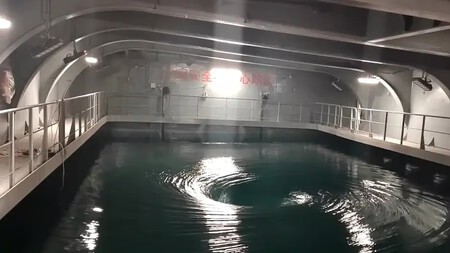
Interior of the Suhai-1
Its initial mission will take it to the cold waters of the Yellow Sea, where temperatures range between 10 and 18 degrees —the ideal conditions for salmon development. The objective is to maintain the fish in optimal environments from their juvenile stages until they reach maturity.
Once the fish are ready, there will be no need to bring them ashore for processing. The ship features on-board processing systems that enable it to fillet, package, and preserve the fish, making it ready for landing and distribution. According to the operators, the product can reach Chinese markets in less than 24 hours after harvest.
To ensure a controlled environment, the Suhai-1 incorporates intelligent systems that regulate five critical factors : water, oxygen, food, lighting, and waste management. Real-time monitoring and coordination occur from a centralized control center on the ship.
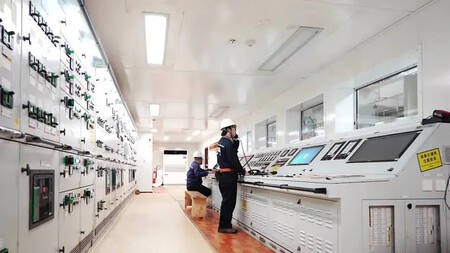
Interior of the Suhai-1
The automated feeding system manages storage, transport, dispensing, and distribution of feed, guided by algorithms that adjust quantities based on fish growth. Additionally, water renewal is accomplished through a system that exchanges water inside the ship with fresh marine water, adapting pressure and flow rate as needed.
Furthermore, the ship is equipped with environmental sensors, underwater surveillance cameras, filtering systems, and an Industrial Processing Plant that operates in two modes: rapid cooling and freezing. Under optimal conditions, fish can be delivered to port and marketed within hours.
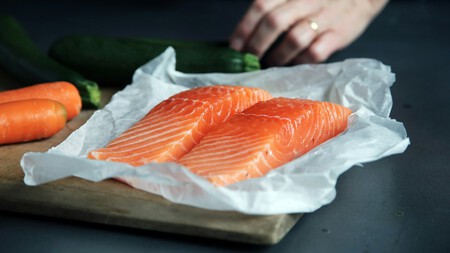
The launch of Suhai-1 is not merely a technological advancement but a response to rising domestic demand. China has emerged as the fastest-growing salmon consumer market globally. In 2024, salmon consumption reached approximately $1.76 billion , marking a 21% increase compared to the previous year.
However, national production currently falls short of this demand. Land-based fish farms produce fewer than 50,000 tons annually , while imports remain high. Suhai-1 aims to reduce this dependency. The plan is to release the first fry this fall and harvest its initial yield by the Dragon Boat Festival next year.
China has long relied on large-scale engineering projects to project its power. Previous endeavors include the Three Gorges Dam and the most extensive high-speed train network globally. Similarly, Suhai-1 embodies this ambition, breaking through technological and operational boundaries.
In Europe, the history of aquaculture spans centuries. The Romans are known to have cultivated fish in artificial ponds. Spain adopted these practices early on, establishing a thriving aquaculture culture that persists today, from Galician mussels to southern estuaries for sea bass and gilt-head bream .
Images | Jiangsu LianShen Marine Technology | Caroline Attwood