
China’s Fujian Aircraft Carrier: A New Era in Naval Warfare
The cover of an aircraft carrier has always been a tension scenario: each takeoff is a millimeter choreography that combines steel and noise. For more than six decades, that scene was dominated by steam. Now, with the Fujian , that script is also written with electricity. We do not talk about an experiment behind closed doors, but of a public demonstration on deck with several different aircraft— the type of test that emphasizes the electromagnetic catapult’s operational efficiency in real conditions.
The demonstration was not accidental. It coincided with the acts for the 80th anniversary of victory in the war against Japan and World War II, where prominence also passed through the sea. According to the Ministry of Defense, the Fujian served as a platform for three different models: the J-15T and J-35 fighters and the KJ-600 early alert plane. The three performed catapult launches and landing maneuvers with cables, marking a new chapter in their aircraft preparation.
What was tested. According to Xinhua, the training phase served to check the interaction between the electromagnetic catapult, the braking system, and various aircraft. The Navy explained that the exercises confirmed the “good compatibility” of the systems and that the Fujian already has the capability of “full initial deck.” In practice, this means that it can organize launch and recovery operations sequentially, preparing the groundwork for broader integration of its embarked wing .
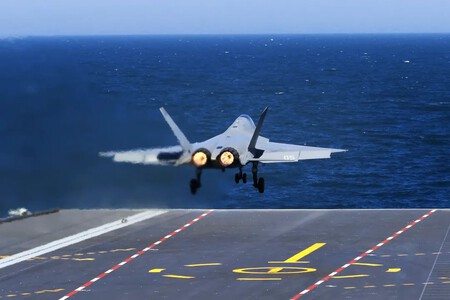
From steam to electromagnetism: For a long time, steam catapults marked the take-off routine on aircraft carriers. The EMALS (Electromagnetic Aircraft Launch System) American system introduced a paradigm shift: instead of pressurized steam , it uses accumulated electric power converted into launch force. It is already installed in the USS Gerald R. Ford (CVN-78), the first aircraft carrier to incorporate it. The US Navy emphasizes that EMALS offers greater acceleration control, less wear on aircraft, and the ability to launch everything from light drones to heavy fighters. This transition reduces maintenance and opens operational ranges.
Three aircraft, three missions. The J-15T is the evolution of a veteran naval fighter, adapted to operate with catapults. Its role is to ensure the continuity of the air operations while more advanced models arrive. The J-35 , on the other hand, represents the leap to the fifth generation, featuring stealth capabilities with greater range and modern sensors. The KJ-600 early alert plane rounds out the trio, designed to expand the combat group and coordinate operations over hundreds of kilometers.
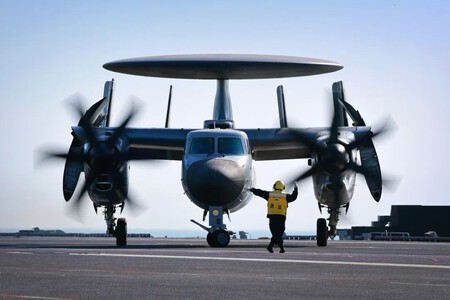
Where is the Fujian today. The aircraft carrier began its sea tests in May 2024 and has since followed a progressive calendar. System and stability checks have been performed, alongside rehearsing cover operations. The latest exercises indicate that the ship has an initial capacity to operate with different aircraft, but it has not yet reached the full operability required for long-range missions.
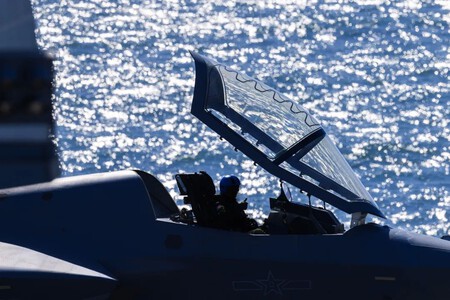
Only two with Catapult EM. To date, only two navies have successfully integrated electromagnetic catapults into service aircraft carriers. As previously mentioned, the United States operates EM catapults aboard the Gerald R. Ford , while China has demonstrated its operation on the Fujian . These advancements place both nations in a high technological category , while other countries continue to rely on steam systems or do not possess catapults. This milestone reflects the significant investment and industrial development necessary to achieve this.
What changes on deck. The electromagnetic catapult opens a new range of operational possibilities. It allows light drones or aircraft to be launched with the same reliability as heavier models, while significantly reducing mechanical stress and vibration. For the crew, the work environment is quieter and less hot. Practically, this translates to a higher number of daily launches with less maintenance between operations.
Of the test at the service. The maneuvers conducted this month do not yet signify that the Fujian is a fully operational aircraft carrier. While it is in an early phase, it needs to accumulate many more hours at sea and certify maneuvers under diverse conditions before being able to deploy its embarked wing in actual campaigns. The Ministry of Defense has hailed this as a milestone, but acknowledges that further development is needed. The transition from demonstration to real capability will be gradual, reliant on system performance in more demanding scenarios.
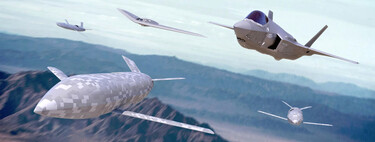
The Fujian has transitioned from a project steeped in speculation to an aircraft carrier visibly demonstrating its operational capabilities, particularly regarding its electromagnetic catapult. The achievements this month are not just technical completions but confirmations of strategic intentions. Moving forward, the trajectory of the Fujian will dictate how quickly these maneuvers become routine within a fleet capable of sustained operations in the open seas.