

The Grand Military Parade in Beijing: A Display of Power and Ambition
On September 3, Beijing staged one of the most elaborate Chinese military parades ever seen, commemorating the 80th anniversary of the end of World War II . This elaborate event was designed to promote nationalism , showcasing China’s aspirations on the global stage. The parade served as a platform for President Xi Jinping to convey his vision for a new world order, with China positioned at the forefront.
Featuring a diverse array of military artillery , this parade was designed to send an unambiguous message: China’s military capabilities have evolved, and they are positioning themselves as a formidable power with no limits in ambition.
Artillery as Support: The Beijing military parade aimed to illustrate the realities of Xi Jinping’s ambitions, showcasing new intercontinental ballistic missiles, specifically the DF-61 , which is said to be the successor of the DF-41 . This advanced arsenal includes missiles equipped with hypersonic technology , enabling them to travel at speeds exceeding five times the speed of sound. The combination of artillery and technology presented a clear commitment to modern warfare, solidifying China’s place as a global military leader.
The demonstration also highlighted a wide array of drones , both aerial and naval, which serve diverse functions ranging from direct combat operations to logistical support. Some drones were specifically designed as “faithful squires” to stealth fighters , underscoring the People’s Liberation Army’s (PLA) commitment to autonomous warfare .
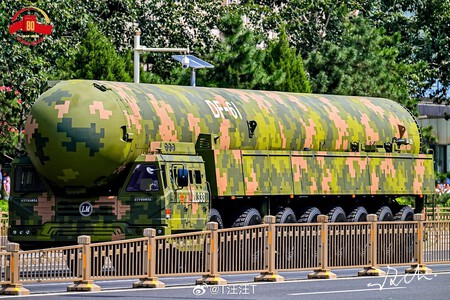
DF-61 Intercontinental Ballistic Missile
Directed Energy Weapons: Another significant aspect of the parade was the presentation of laser and directed energy weapons . Both naval and terrestrial versions were showcased, exhibiting capabilities to neutralize enemy sensors and drones at remarkably low costs when compared to traditional munitions. If implemented widely, these systems could completely reshape the military landscape and pose a daunting challenge to any forces trying to counteract China’s growing military influence.
This shift towards technological warfare, backed by immense industrial capacity, emphasizes a strategy where quantity and sophistication synergize to establish China’s strategic dominance.
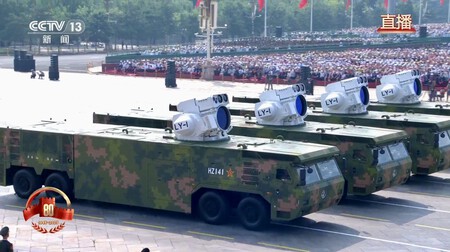
Set of laser weapons during the military parade
Submarine Drones: The parade also marked the debut of underwater drones , further solidifying China’s leadership in this domain. Two models were presented, including the AJX002 , measuring between 18 to 20 meters long. Analysts speculate that these submarines could be used for reconnaissance or for carrying out naval operations, thereby ensuring a strategic edge in underwater warfare.
The YJ-17 hypersonic missile also made headlines as it combines naval capabilities with the advanced technology of the DF-17 . This missile’s adaptations for vertical launch from warships suggest its potential to carry both conventional and potentially nuclear payloads, enhancing its deterrence value.
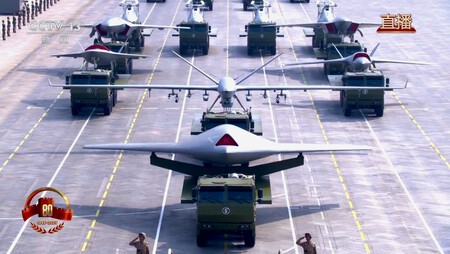
Non-manned wing aircraft of the PLA
Beijing’s Industrial Might: The military parade was a testament to the mass production capabilities of China. Analysts like Malcolm Davis have noted that the nation can develop, manufacture, and deploy advanced military technologies faster than the West. This capability serves as a reminder that while the American military held sway during the Second World War, today’s landscape is changing with China’s military production achieving remarkable efficiency in a way that rivals the West’s pace.
Data from the Center for Strategic and International Studies (CSIS) indicates that China’s military expenditure has increased thirteenfold over the past 30 years, surpassing its nearby nations’ military spending. This growing arsenal signifies a potential threat to the balance of power in Asia and beyond.
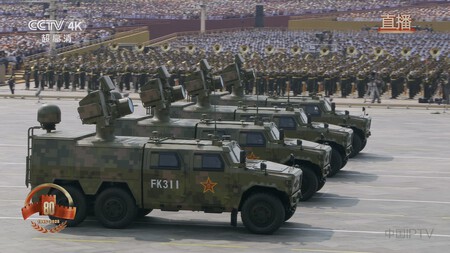
Anti-Enlambre Training demonstration
The Naval Dimension: Compared to the United States, China’s naval power is poised to increase significantly by 2030 , potentially boasting 48% more warships than the U.S. Such a shift revives historical notions that the larger fleet usually comes to dominate in maritime conflicts. While Western nations may be relying on technological superiority, the Chinese parade revealed that they already have operational advanced autonomous systems .
In the face of America’s potential reliance on drone swarms armed with artificial intelligence, China’s advancements in laser defense systems against missile and drone attacks shed light on their strategy of intelligent warfare , focused on autonomy and networked operation.
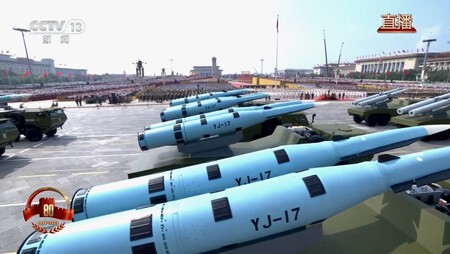
JY-17 Radar System
Hypersonic Arsenal at Sea: The YJ-17 was not the sole hypersonic missile displayed; it was accompanied by other anti-ship missiles such as the YJ-15, YJ-19, and YJ-20 . These missiles are designed for rapid deployment from modern naval vessels, further reinstating the notion that U.S. aircraft carriers may face vulnerabilities in the Asia-Pacific region.
This newly demonstrated capacity aligns with China’s strategy to modernize its military arsenal and diminish the influence of American power in the region. However, questions remain regarding the Chinese military’s experience ; China’s last major engagement was in 1979, which raises concerns about its ability to apply this advanced technology effectively in real combat scenarios.

Closing the Gap: The Beijing parade powerfully demonstrated China’s technological advancements and military self-sufficiency , signifying a potential restructuring of the strategic balance in both Asia and the Pacific. Nevertheless, many analysts emphasize that while such displays generate vibrant imagery, they do not biblically represent the military’s effectiveness in real-world scenarios.
In conclusion, although the United States retains its position as the leading military power, the gap is narrowing rapidly. China is quickly advancing due to its industrial independence and a modernization wave that cannot be ignored. The critical question remains — how will these capabilities perform in the ultimate test: real combat? Only time will reveal the answers.