
Assembly of the Most Powerful Impulse Turbine in Tibet
Imagine moving a 32-ton steel structure along a mountain road, fitting it into a rock-excavated site, and securing it with a tolerance of just a few millimeters. This is the monumental task that China has undertaken in Tibet (Xizang): assembling the IMPULSE turbine , the most powerful ever built. Just a month ago, we discussed the design and transportation of this machinery to a remote location. Now, the real challenge begins—ensuring that every part is assembled with precision, utilizing gigantic cranes, digital simulations, and meticulous measurements in a confined space.
The First Major Component: Water Distribution Ring
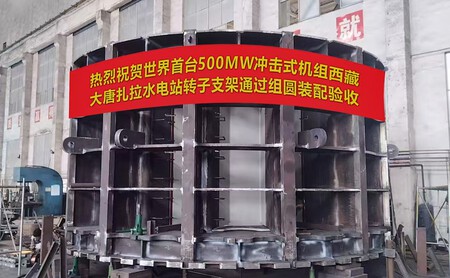
The first key piece is already in place. According to Global Times, the assembly has commenced with a crucial component: a section of the water distribution ring. This substantial structure, designed to channel flow to the turbine, weighs a staggering 32.1 tons , boasts a diameter of 3.1 meters , and has a wall thickness of 95 mm . It was positioned using a 400-ton crane , highlighting the complexity and challenges of this venture.
A Giant Turbine with Precision Engineering
A giant turbine designed with watchmaking precision is at the heart of the Datang Zala project. This impulse turbine has a capacity of 500 MW , making it the most powerful turbine of its kind globally. As reported by Xinhua, the turbine has been entirely developed in China by Harbin Electric Machinery. It integrates 21 hydraulic spoons , each measuring 6.23 meters in diameter and weighing around 80 tons .
Engineering Challenges at High Altitude
Altitude, space, and steel present unique challenges. Each component must be maneuvered in a large-altitude canyon, often leading to structural fragmentation. The distribution ring measures 28m × 25.2m × 4m and is divided into 13 sections for transport and assembly. The project utilizes BIM/3D modeling , 1:1 scale models designed for the highlands, and a specialized welding process that incorporates high-strength steel developed in collaboration with universities. These innovations aim to minimize maneuvering difficulties and ensure the structural integrity of the turbine.
A Strategic Component in China’s Energy Strategy
This turbine is a key piece in the country’s energy strategy. The Datang Zala project signifies Tibet’s first hydroelectric venture at the 1 million kW level, set to become a critical node in the energy network of western China. Its construction aims to enhance renewable energy offerings in the region, facilitating integration into the national power grid while navigating the complexities of its geographical landscape.
Official statistics indicate that China has constructed over 94,000 dams with an installed hydroelectric capacity of 436 GW . Annual generation is pegged at 1.42 billion kWh , which accounts for a significant 57% of its total renewable energy production. The Datang Zala project aligns with China’s overarching strategy of developing large-scale infrastructure to ensure a consistent energy supply, reduce reliance on coal, and stabilize the national grid.

Looking Ahead: What’s Next?
Much work ahead lies in completing the turbine installation. Critical components, hydraulic connections, and operational tests at height remain outstanding. Reports indicate that the project is expected to commence operations by 2028 . Assembly will continue in the following months, with any deviations possibly delaying the completion date.
Images | Dongfang Electric | Datang Xizang Energy Development
In conclusion, the Datang Zala project is not just another infrastructure endeavor; it represents a giant leap towards sustainable energy in Tibet and integrates advanced technology and construction methods that could set benchmarks for future projects globally. As the assembly progresses, the world watches closely, eager to witness the culmination of engineering prowess and environmental commitment.