
The Chinese military aviation has been quietly developing its capabilities over the years, with the latest insights into the J-36, its future stealth fighter , revealing a remarkable technical ambition . The most recent image, shared on social media and covered by outlets like The War Zone and The Aviationist, shows what appears to be a sharp frontal view of the aircraft, with the cockpit and fuselage prominently displayed. Analysis suggests the photograph was taken with a telephoto lens from a low angle and potentially shows an image of a screen, introducing possible distortions.
Despite the visual anomalies—such as areas near the dorsal intake and landing gear, which could be attributed to a reflection of the camouflage or even an optical flaw—the context of the image appears to support its legitimacy. The background aligns with the Chengdu Aircraft Corporation , notably featuring a large hangar and a thrust dissipation barrier that has already been documented at that location. While not an official confirmation, these coincidences carry significant weight.
An element that stands out. Greenish reflections hint at two independent HUD displays , bolstering the theory of a side-by-side seating configuration . This design is unusual in modern fighter aircraft but can be found in models like the Russian Su-34 and the American F-111. This configuration may be intended for complex missions that require simultaneous management of sensors, munitions, and electronic countermeasures—tasks that are difficult for a single pilot to handle effectively.
A main bay with two side compartments: more space, more options. Another detail reinforcing the uniqueness of the J-36 is evident beneath its fuselage. The image displays three open doors: one central, large door flanked by two smaller ones. These do not correspond to the landing gear doors already identified in previous images, suggesting they serve as additional weapon bays . This possibility had been proposed in prior analyses, but clear visual evidence was lacking until now.
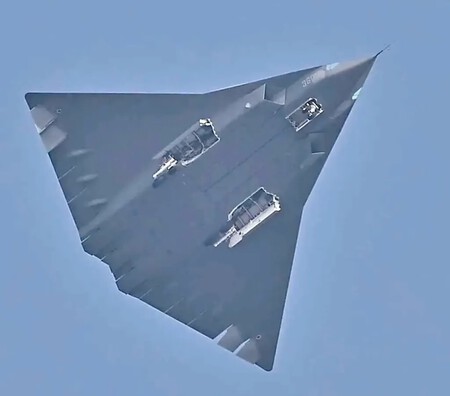
This configuration makes operational sense. The side bays could be reserved for air-to-air missiles or smaller precision-guided munitions, while the central bay would accommodate larger weapons such as cruise missiles or long-range projectiles . This distribution enhances tactical flexibility without compromising stealth. The architecture somewhat resembles the J-20 but boasts a greater internal volume, prioritizing range and load capacity over pure maneuverability.
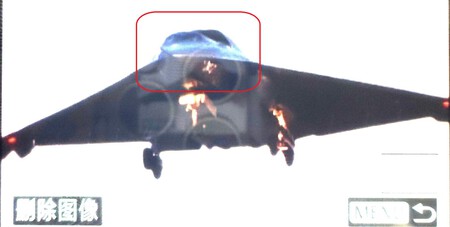
A non-conventional design. The image also reveals other key elements. Windows on either side of the nose may correspond to optical or infrared sensors . Below the cockpit, trapezoidal air intakes reminiscent of the F-22 are noticeable. Above, the dorsal inlet suggests a triple-engine configuration , which is rare in combat aircraft but aligns with the size and profile of the J-36.
A project that defies classification. The debate regarding the classification of the J-36 remains ongoing. Referring to the J-36 as merely a “ bomber ” or a “ heavy fighter ” seems insufficient at this stage. Like the American B-21 , the boundaries between categories have become blurry. In this context, some outlets prefer to describe it as a “ next-generation platform ,” a term that better reflects the complexity of current developments.
Each image provides a clue but also raises new questions. Until official confirmations are made, everything known about the J-36 will continue to rely on leaks, visual analyses, and technical context. However, one thing is becoming clearer: China is not merely seeking a sixth-generation stealth fighter but is looking to develop a large platform with range, stealth, and the capacity to perform a diverse array of missions.
Images | @WZZJWZ
In Xataka | We have been tying ribbons on luggage for identification at airports. Employees warn that it’s a terrible idea.