
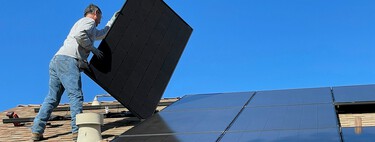
In recent decades, electric self-consumption has experienced unstoppable growth in many countries. Initially, we saw roofs adorned with photovoltaic panels , followed by the advent of solar balconies . Now, innovation takes an even more ambitious leap: converting regular glass windows into clean and transparent energy generators. A team of Chinese researchers has recently unveiled technology that could transform the glass facades of buildings into invisible solar power plants.
A panel that is not a solar panel. The research from the University of Nanjing , published in the journal Photonix, introduces a transparent , colorless, and unidirectional solar concentrator (CUSC). This groundbreaking device can be applied directly to the standard glass of a window, allowing it to capture sunlight without altering its appearance.
How does it work? Essentially, the window retains its original look, but the special coating facilitates the “sliding” of a portion of sunlight to the edges of the glass. Here, small solar cells convert that redirected light into electricity. In summary, the window maintains its transparency but functions as a hidden solar panel.
From a more technical point of view. The innovation lies in the application of layers of cholesteric liquid crystals (CLC) , which selectively redirect sunlight. The glass achieves a visible transparency of 64.2% and a chromatic reproduction index of 91.3, closely resembling that of a standard window. Test results are encouraging: a prototype measuring just one inch was able to power a 10 MW fan under sunlight. Simulations indicate that a two-meter window could concentrate light fifty times and reduce the required amount of solar cells by 75%, as discussed in the research.
Self-consumption reinvents itself. The rise of these innovations aligns with the global BIPV trend (Building Integrated Photovoltaics), emphasizing the integration of photovoltaic systems into architectural elements. As previously noted by Xataka, solar railings—such as the Miterx solar system , which transforms balconies into electricity generators—are already on the market.
Furthermore, Europe plans to mandate that all new construction buildings be zero emissions by 2030. This urgency accelerates the search for solutions that not only generate energy but also respect urban aesthetics and utilize every available surface.
China steps on the accelerator. It is no coincidence that this innovation originates in China. The country has emerged as the largest global laboratory for solar energy , deploying technologies at an unprecedented pace. As reported by Xataka, in the first quarter of 2025 alone, China installed 36 GW of solar energy on roofs—more than Europe has managed over several years. The total reached 60 GW in just three months, a testament to the magnitude of China’s commitment to solar energy.
Against this backdrop, the transparent solar window is not merely a laboratory experiment; it is an essential component of a national strategy aimed at large-scale electrification and decarbonization . While Europe grapples with bureaucratic barriers, China appears resolute in adorning roofs, balconies, and now facades with technologies that produce clean electricity.
Forecasts indicate that the Nanjing team is already working on enhancing the efficiency of broadband, optimizing polarization control, and exploring applications beyond skyscrapers. Agricultural greenhouses and transparent solar screens are among the potential fields where this technology may find use.
“The design of the CUSC represents a significant advancement in integrating solar technology into the built environment without compromising aesthetics,” emphasized Professor Wei Hu, the corresponding author of the study.
A future of generating facades. The cities of tomorrow could be enveloped in glass that not only allows light to pass through but also generates energy. From solar balconies to photovoltaic railings, self-consumption is evolving toward seamless integration into urban architecture.
The window that does not appear to be a solar panel, yet functions as one, emerges as one of the most promising innovations in meeting the climate challenge: envisioning each facade as an invisible solar power plant.
Image | Freepik and Center for Liquid Crystal and Photonics / Nanjing University
Xataka | One of the most arid areas in China is becoming green: the reason is a plant housing seven million solar panels.