
The idea is, at least, singular: send a small symbolic portion of the cremated remains or a person’s DNA to space. That a part of what was a human body experiences zero gravity , goes around the Earth, and becomes a relic for the family. A capsule that acts as a space urn . That’s how it is Earth Rise, one of the services it offers Celestis, an American company with more than 30 years of experience in this business that they define as ” perseverance flights .”
But this time, not everything went as expected. On June 23, an Earth Rise mission transported 166 capsules with human remains and DNA samples. The take-off onboard a Falcon 9 rocket from SpaceX was successful. The capsule, developed by the European company The Exploration Company, managed to enter orbit and completed two laps around the planet, fulfilling the planned flight profile. So far, everything was proceeding as planned.
However, something failed during the reentry process . The NYX capsule, which had to return to Earth and deliver its individual modules to each family, suffered an anomaly . The vehicle was lost shortly after starting its descent, ultimately crashing into the Pacific Ocean . With it, human remains and flight capsules also dispersed. “We believe we can’t recover anything,” recognized Celestis in a statement.
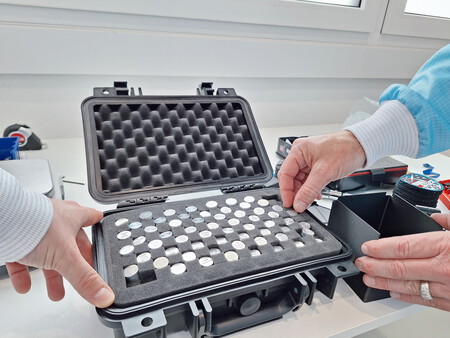
<span>The Celestis container with human remains that traveled inside the NYX capsule</span>The origin of Celestis goes back to 1992, when NASA included a sample of the remains of Gene Roddenberry , creator of ‘ Star Trek ‘, in a mission of the Columbia ferry . Shortly after, Celestis collaborated with the agency to send remains of geologist Eugene Shoemaker to the moon, making him the first buried person there.
Since then, they say, they have sent more than 1,200 capsules to space aboard commercial releases, commemorating both known figures and anonymous citizens. They have various active services: suborbital flights that return to Earth, missions to the lunar orbit, and even to deep space .
Earth Rise: A Farewell with Round-Trip Ticket
Celestis offers several types of commemorative spatial flights, but Earth Rise is the most economical and direct. For $3,495 , the company launches a small capsule with cremated remains or DNA. After experiencing several minutes in microgravity , the capsule returns to Earth and becomes a souvenir for family members. It is a trajectory that seeks symbolism, not permanence.
For those seeking something more ambitious, there are also other options:
- Earth Orbit: For $4,995 , the capsules enter into terrestrial orbit and remain there until they disintegrate in the atmosphere, “like a fleeting star.”
- Moon: For $12,995 , the remains are sent to the lunar orbit or even land on the surface, “becoming a permanent mark on the moon.”
- Voyager: Also starting at $12,995 , this service launches the capsules into deep space, beyond the moon, on a one-way trajectory .
A European Space Capsule
The capsule that transported the human remains on the Perseverance flight was not just any space vehicle. It was NYX , a prototype developed by The Exploration Company , a startup with presence in Germany , France , and Italy that aims to establish itself in the new European space race. Their proposal is clear: create reusable, rechargeable capsules in orbit, compatible with any heavy launcher worldwide.
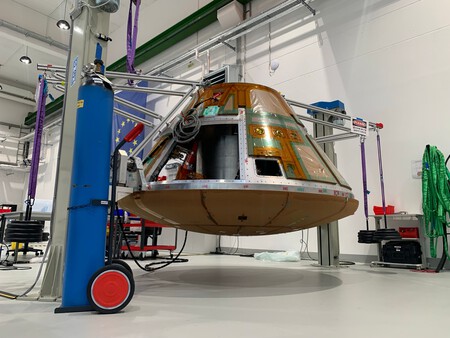
<span>The NYX capsule, prepared for its mission, at The Exploration Company facilities</span>According to their website, the company was founded in 2021 by Hélène Huby and a team of engineers with experience in large European programs such as Orion-Esm , Ariane , or ATV . In just three years, they have built two demonstration capsules and have sold six missions. Their development rate has been unusually rapid for the sector.
The flight Mission Possible, in which Celestis’s funeral capsules were traveling, was the second demonstration mission of the company. It was designed to perform a controlled reentry and recover the payload after completing the mission. That was, in fact, one of its key technological promises: not only to reach space but also to return swiftly and accurately.
<img alt="Spacex has asked Mexico to stop invading its property and returns the starship pieces that fell into the country" width="375" height="142" src="https://i.blogs.es/927327/1920_1280/375_142.jpeg"/>It was also the first time that a private capsule of European origin offered that type of commercial service in collaboration with Celestis . The mission was an essential step for The Exploration Company , which aspires to compete in the growing orbital transport market with its future NYX Earth capsule, designed to supply space stations in low orbit.
The families expected to receive a capsule that had orbited the Earth, a symbolic and emotional tribute for those who decided to opt for this unique form of farewell. It was not possible. What remains is a story of ambition and failures . All we can do now is wait to see if Celestis will attempt another mission in the future.
Images | Celestis/Exploration Company (1, 2, 3, 4)
In Xataka | Taiwan believes it has found the mythical Planet 9 of the Solar System. Instead of looking for its light, it has been searching for its heat.