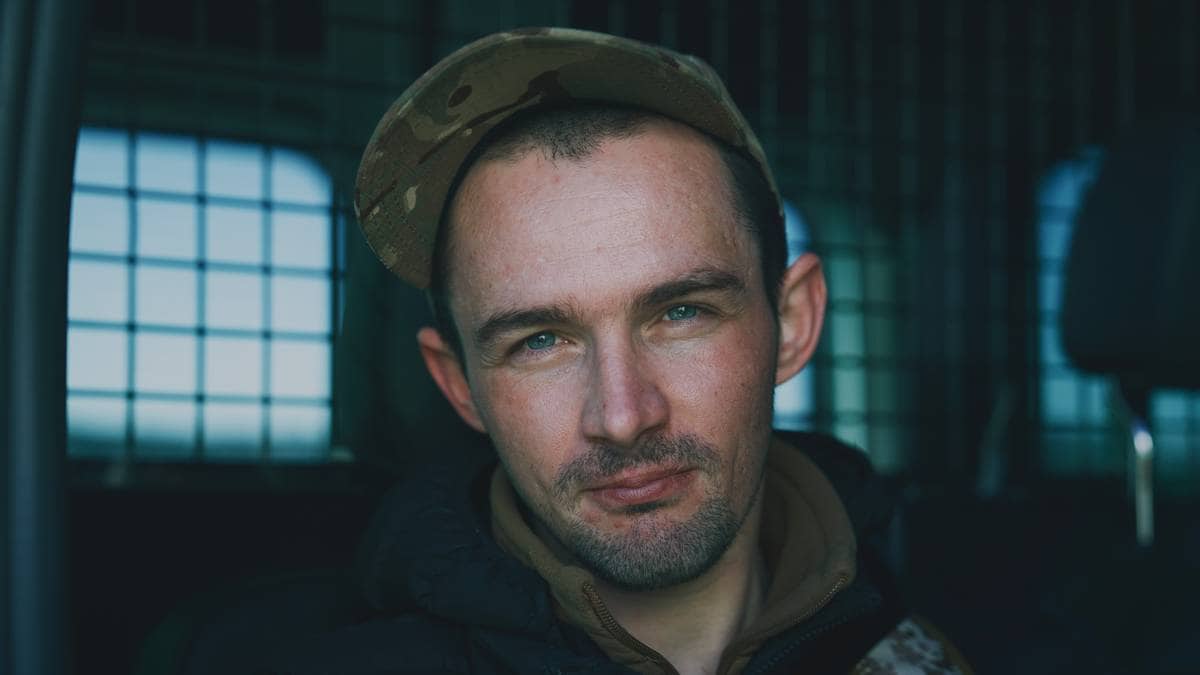
The soldier is thinly dressed. The window has been open tonight. It is freezing on the cell, and he freezes. But he knows it gets worse when the prison guards come and pick him up. – Some days we were knocked around the clock, he says. This is how Illia Morozyuk (27) describes everyday life as a prisoner in the Russian prisons. To Norway news hits him at the largest hospital in Lviv, west of Ukraine, two months after he was released from Russian captivity. Soon he will be transported out of Ukraine with an ambulance bus to an evacuation aircraft on the Polish side of the border. Then he is on board a plane for the first time in his life. The aircraft is an ambulance flight, and the goal is Norway. The soldier is dressed in a black training suit. Over the shoulder hangs a stomach belt with the most important, and on the floor is a camouflage sack packed with some clothes. Injured in the Kherson offensive Brigade Illia served in, the 128th Mountain Assault Brigade, participated in the Ukrainian counter-offensive in the Kherson region in the fall of 2022. In the offensive, the Ukrainian forces succeeded to push Russian back to the Russians back. Illia served in the 128th Mountain Assault Brigade. This photo was taken during training in 2022. Photo: Private This is where Illia had to lose October 15, 2022. – We were on a mission when we were shot with artillery. That’s when I was injured and captured by Russian soldiers. It was the start of a two and a half year long stay in Russian prisons, first in the occupied areas, but for most of the time in Volgograd Oblast in Russia. Splint residue in the arm Illia is clearly characterized when he talks about time in prison, but at the same time wants to share his story and talk about how the Russians treat Ukrainian prisoners of war. – I saw a man, around 60 years old, who was knocked so hard that he had major health problems. He died there, Illia says, breathing to control the tremors in the body. – Why are you going to Norway? -I will be operated in a hospital there, says the 27-year-old and shows off the right hand. The hand is completely deformed and two of the fingers are connected. Then he pulls up the sweater and shows off the scars up his arm. – I have splint residues there and there, he says, pointing to the scars. news cannot go to history Illia tells from time in Russian captivity, but several soldiers have told similar stories, and last year the UN published a report indicating widespread torture in Russian prisons. Fortunately, on February 5 this year, the prison stay ended. Then Illia was one of the 150 Ukrainian prisoners exchanged with Russian prisoners. – I didn’t think it was true that I should be exchanged. I thought we were going to another prison. It wasn’t until I saw the Ukrainian flag that I believed in it, says Illia. Illia was released on February 5 this year in a prison exchange with Russia. Photo: Television News Service, Ukraine is transported by Norwegian ambulance buses on the same day Illia will be evacuated from Ukraine, waiting for 25 other patients in the hospital in LVIV. Most are soldiers injured at the front, but there are also some civilians who need cancer treatment. Patients are transported by ambulance buses from the hospital to the city of Rzeszow in Poland. Illia smiles crooked when his name is read and fires some glosses on the way out to the bus. Although the prison stay characterizes him, he has preserved a kind of camaraderie and a sense of humor. He is one of the few soldiers who do not take a smoke until the seven -hour bus trip to Poland, and he manages to get to the bus on his own. But several of the soldiers are so badly damaged that they have to be rolled out on stretcher. Know little about Norway it is surprisingly cold this April day, and there is snow in the air. When the bus makes a stop just before the border crossing, only the most eager smokers go out for a blow. Illia, which comes from a small village south of Kyiv Oblast, has never been outside Ukraine except for her stay in Russian prison. He knows little about Norway, and it is a coincidence that it is Norway he is going to. – I was recommended to apply for evacuation for treatment abroad. When I received the application approved, it turned out that Norway could offer treatment, he says. The nervousness seems to have settled, and he looks forward to the flight. Remodeled SAS aircraft The aircraft, which is waiting in Rzeszow, is a rebuilt SAS aircraft with civilian employees from SAS and sanitation personnel from the Armed Forces. Photo: Frode Fjerdingstad / news It acts as an evacuation aircraft, and has been in use since the summer of 2022. The evacuation process takes place under the auspices of the EU’s civil preparedness scheme. – The Norwegian contribution is big and we are very grateful, says Kateryna from the Ukrainian Ministry of Health. She coordinates the evacuation work from Kyiv and praises Norway’s efforts. – A lot is happening in collaboration with Norway. Norway provides its own aircraft and a team that fetches patients in Poland and transports them to other countries in Europe. Norway is also among the countries that receive the most patients, she says. Photo: Frode Fjerdingstad / news Illia sits in the middle of the plane. In front of him are injured soldiers on stretcher. Several of them have split injuries in the legs and are in great pain. One of them shouts loudly with pain and immediately gets a dose of painkillers before the plane takes off. The aircraft is almost fully loaded with injured soldiers on their way to treatment somewhere in Europe. Today, the aircraft will first go to Frankfurt, then it will continue to Amsterdam and Hamburg, before it lands in Oslo. Illia finds it difficult to put into words what he feels when the plane is in the air, but acknowledges that he feels a relief. “Everything feels good,” he says, smiling. 156 missions 156 times the Norwegian team has evacuated patients, both civilian and military, since the full -scale war started. A total of 3299 patients and relatives have been evacuated. More than 700 of them to Norway. – When you see war injuries as often as we do, we get an impression of what is happening in Europe. We see that the war is no more than two hours away by plane, says Bjørn Eidissen. He is a chief sergeant in the Armed Forces’ sanitation and has participated in these evacuation operations since its inception in the summer of 2022. Finished the war as the plane approaches Norway, Illia looks out of the flight window, and says it feels good to leave the war. He knows little about what awaits him in Norway. The only thing he knows is that he will operate his hand. – And then I know I’m not going back to the war. It’s over for me, says Illia. Photo: Frode Fjerdingstad / news
ttn-69