
Navigating Tensions: The Current Geopolitical Landscape in the Baltic Sea
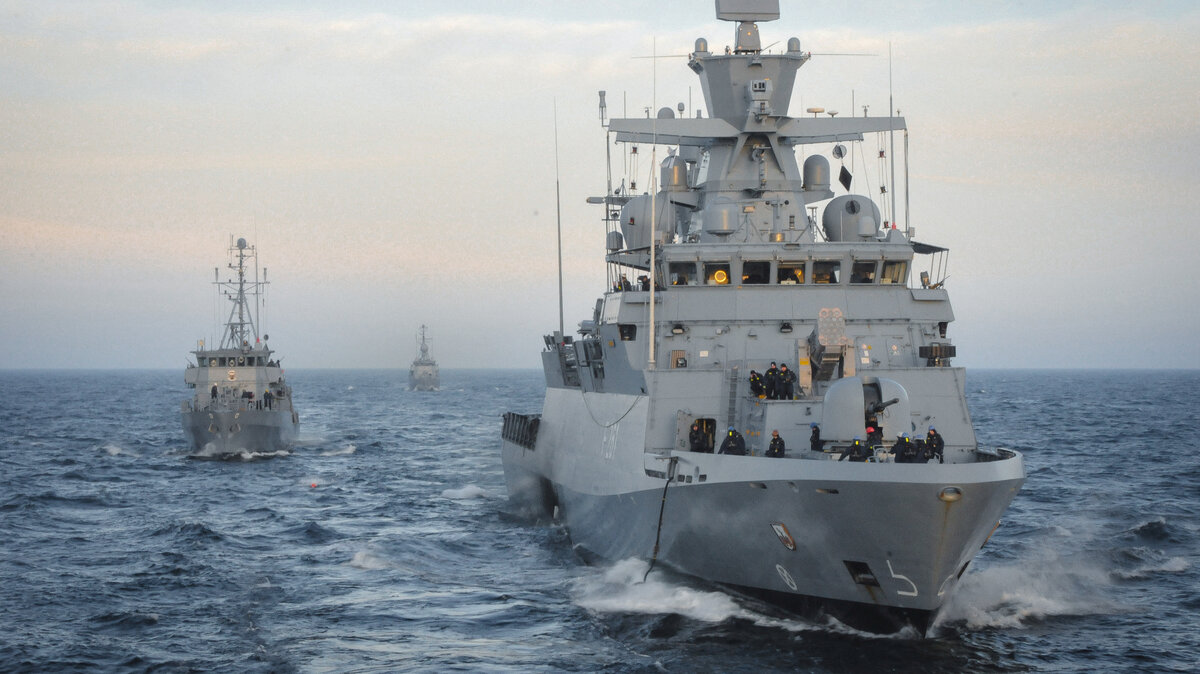
Um shortly after 8 AM, we shift into stealth mode. The transponder signals from the mine hunter “Pegnitz” and other ships become untraceable through the AIS identification system. Mobile phones must be switched off, and electronic devices are stowed away in lockers. Tension fills the air aboard the German supply vessel “Mosel,” a hundred-meter-long ship leading this maneuver.
Commander Stefan Ladewich stands watch with several officers on the Nock, the open lookout area on the bridge, gazing toward the bow: through the crane, container loading, and deck guns, he surveys the narrow exit of the Gdańsk harbor. A soldier stands by a heavy machine gun next to him, clad in a balaclava, ear protection, and a tactical vest. Everyone is at their posts. The Russian Kaliningrad and its navy are only about 40 nautical miles away. It’s serious.
Slowly, the gray supply ship pushes past the container and cruise ship terminals, heading out into the Gdańsk Bay and toward open sea. It is early April, a brisk spring day, marking the beginning of the second part of a NATO joint exercise involving partners from Norway, Estonia, and Lithuania, among others—a total of twelve units from eight nations.
In five days, the fleet will proceed from Gdańsk to Kiel. Five days at sea, which the reporter will spend aboard the “Mosel” with over 100 soldiers, devoid of Netflix, WhatsApp, or Instagram, but filled with the smell of diesel and swaying nights in a narrow bunk behind waterproof bulkheads. It’s a stark reminder of the looming threat of war between NATO and Russia, which is not merely on the horizon but has already materialized.
Heightened Tensions Like Never Before
The directive to switch off personal devices stems from the heightened geopolitical climate. Since the onset of the Ukraine war in 2022, reports have emerged of strong signals unexpectedly surfacing in the middle of the ocean. This can serve as a trap: inconspicuous vessels may carry false transmitter masts to which mobile devices automatically connect. Russia could intercept crew data this way. Commander Ladewich notes past incidents where family members received distressing phone calls meant to create uncertainty—an example of “asymmetrical, hybrid warfare.”
It has been decades since the geopolitical situation in the Baltic has been this tense. With Sweden and Finland joining NATO in 2024, Russia will be the only non-NATO country bordering the region near St. Petersburg and the exclave of Kaliningrad. For the Baltic states and Finland, an open supply route by sea is crucial.
The Navy’s mission increasingly focuses on the protection of critical infrastructure —news of sabotage against underwater cables and espionage incidents have become more frequent. Putin continues to test the “red lines” of the West, remarked BND Chief Bruno Kahl at the end of December, emphasizing that Germany is considered a declared “enemy.”
The crew aboard the “Mosel” feels the weight of the situation. On the way to Gdańsk earlier in April, a severe incident occurred involving Russian warships nearby as several drones approached them. One came dangerously close—measuring two meters in wingspan, not a recreational model, with its origin officially unknown. “Threat Warning Surface Yellow, Threat Warning Air Yellow,” blared over the loudspeakers—a warning level indicating a potential attack from the surface and the air.
An Uncommon Disruption
The tender “Mosel” roused its crew and sounded the alert march, the second-highest alarm level, also known as a wartime march. One soldier managed to intercept one of the drones using an electronic countermeasure device.
A few days later, the reporter witnessed the action himself: shouldering the over eight-kilogram device, resembling a futuristic rocket launcher, he aimed it toward the horizon. The “Effektor HP-47,” as the Bundeswehr calls this equipment, can jam the GPS and remote control of the drone from several kilometers away.
Had the interception failed earlier in April, Commander Ladewich might have had to order the drone to be shot down with one of the machine guns. The drones likely aimed to scout or lure NATO ships out of hiding. The presence of such aerial support would have been unacceptable for the commander. This is why weapons are manned when leaving the Gdańsk Bay.
This was not the only incident during the exercise. On the evening of April 3, GPS satellite systems experienced extensive failures while the ships were entering the Gdańsk Bay. For hours, commercial and leisure vessels struggled with navigation. The Gdańsk Bay stretches in a roughly 100-kilometer-wide semicircle from the Polish cities of Gdynia and Gdańsk in the west to the Russian exclave of Kaliningrad in the east.
Previous GPS failures have occurred here, but not on such a scale. Researchers from the Maritime University of Gdynia and the Polish company GPSPATRON investigated disturbances toward the end of 2024 and concluded that they likely stemmed from a “mobile maritime source”—a ship. The extent, duration, and peculiarities of the disruption led the researchers to suspect a “military technical device” as the cause.
Was It Russia?
Regarding the early April incident in Gdańsk Bay—was it indeed Russia?
Speaking with soldiers aboard the “Mosel,” the answer is clear. However, nobody is willing to make a definitive statement. This is partly due to the presence of press officers who ensure discussions remain measured and that no one makes remarks that could worsen the geopolitical situation. In this carefully constructed narrative, Russia is never referred to as the “enemy” but always as a “neutral nation.”
Nevertheless, no one aboard the “Mosel” seems keen for war. One officer reflects nostalgically on how crews from Russian and German warships respected one another at sea only a few years ago, saluting each other—a practice rooted in “good seamanship.”
The Navy, often associated with male camaraderie and unpleasant behavior, showcases a different reality aboard. Female soldiers serve in all capacities on the “Mosel,” alongside individuals like Captain Lieutenant Armin, the first watch officer, who commands after Commander Ladewich.
Peace is Always Relative
Captain Lieutenant Armin sports tattoos on both arms, employs inclusive language, and is actively involved outside of the Navy in SPD and refugee assistance. A pair of Chuck Taylors rests in front of his cabin, while a feminist poster reading: “Cinnamon rolls not gender rolls” adorns the wall. Armin articulates sentiments such as his choice to join the Navy to honor the “relative freedom and peace” he enjoyed while growing up, wishing to give back to his country. “The profession of a soldier is precisely for these situations where freedom and peace seem threatened—that was clear to me back then.”
The relativity of peace hits home for the reporter by the second day aboard. At 7:13 AM, shortly after the morning wake-up call, a message from the first watch officer Armin rings through the ship’s loudspeakers. Two vessels, attributed to the shadow fleet and accompanied by two Russian warships, are nearby.
Such situations incite a flurry of activity aboard the “Mosel.” Soldiers dash to their stations while officers ascend the numerous steps in the central staircase to the bridge.
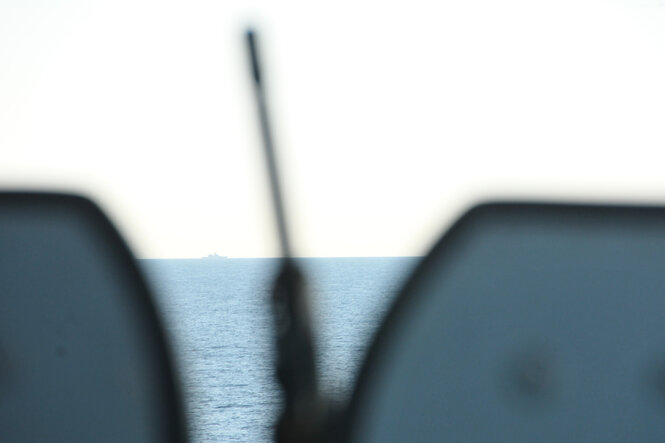
Fregattenkapitän Mario Bewert stands outside the bridge. As commander, he leads the maneuver. Concentrating, he points toward the horizon. A careful eye reveals silhouettes of two merchant vessels, flanked by two warships recognizable by their distinctive towers with radar and antennas. Laminated photos labeled “suspect fisherman” adorn the door to assist in identifying potential threats.
The vessels underway this day bear the names “Sparta IV” and “General Skobelev”—a container ship and a tanker, reportedly en route from St. Petersburg to Port Said in Egypt. Both have been frequently flagged on industry platforms as part of the so-called “Syria Express,” allegedly used for transporting weapons and ammunition between Syria and Russia.
Suspicion of Illegal Trade
On the other hand, the “General Skobelev” has been suspected of participating in illegal trade involving sanctioned cargoes, reportedly assisting in circumventing the oil price cap. The ship has repeatedly drawn attention due to potential violations of environmental and safety regulations.
Why hasn’t the German Navy intervened? “We are in international waters, and the Russians have the same right as we do to navigate here. We sailed by without making contact. However, the ships were monitored.” This implies that a soldier had taken photographs with a near one-meter-long zoom lens. The reporter gains no insight into whether more sophisticated surveillance techniques were also employed.
Observing these ships closely and creating a “situation report” in the Baltic Sea is a crucial task for the German Navy. Since January 2025, this has been done under NATO’s “Baltic Sentry” mission, responding to concerns regarding maritime critical infrastructure in the Baltic. Data cables, power lines, and pipelines crisscross the ocean floor here.
While private operators are initially responsible for securing these assets, the awareness of the maritime critical infrastructure’s vulnerability heightened significantly following the destruction of three of four strands of the Nord Stream pipelines by allegedly Ukrainian forces in September 2022. The Baltic Sea is now monitored more intensively using warships, drones, and aircraft. However, aerial surveillance does not extend below the water’s surface, making monitoring significantly challenging.
Maneuvers like the one in April, which primarily involve mine hunters like the “Pegnitz” or the “Weilheim,” have acquired new significance. These boats, equipped with sonar systems and underwater drones, were also involved in the investigation of the Nord Stream pipeline attack. In recent years, mine hunters have been focused primarily on dealing with wartime remnants. Hundreds of thousands of tons of munitions and naval mines from the First and Second World Wars remain on the Baltic Sea floor, some of which are still operational.
A Moment of Peaceful Expanse
For the past three years, the world has witnessed how crucial the battle against sea mines remains today: Ukraine has managed to keep the feared Russian Black Sea Fleet at bay using them. Russia also employs sea mines, which could severely disrupt supply lines for countries like Finland, whose supply chains rely heavily on maritime routes across the Baltic.
Mine hunters are now additionally tasked with securing critical infrastructure on the seabed. To observe this firsthand, the reporter joins two other journalists to visit the mine-hunting vessel “Weilheim.”
For the trip in a Zodiac inflatable boat with an aluminum hull, known as “Gecko” by the Navy, we don bright red survival suits, donning life jackets and helmets. The water temperature in the Baltic is a chilling 6 degrees Celsius—anyone falling in without protective gear is unlikely to survive for long. Just a day earlier, the waves were crashing against the hull, formidable enough to tower nearly two meters before us. The boat soared at full speed of 36 knots, jolting every occupant, subjecting journalists and crew alike to considerable discomfort.
Yet today, the sea is calm. All around, only the horizon offers a peaceful expanse, at least for this brief moment.
After a few minutes, the small craft collides with the gray side of the “Weilheim.” We scramble over a rope ladder aboard. Commander Maximilian Hirnstein, a man with a short dark beard and a shy smile, greets us. With three golden stripes on his shoulder, the mid-thirties officer commands the vessel, which normally carries 42 crew members across its 54-meter and nine-meter expanse. Hirnstein took command of the “Weilheim” in 2022 from Beata Król, who subsequently led the NATO’s permanent mine countermeasure group.
On the aft deck, soldiers await a device resembling a small torpedo. This is the “Seefuchs”—a drone capable of being deployed to the seabed via a cable. How long is the cable? “Secret,” replies one of the officers. However, it can exceed 450 meters, more than the deepest point in the Baltic Sea.
An “Utopian” Task
As we navigate further aboard, we pass a group of mine divers waiting by a pressure equalization chamber, attempting to avoid bumping our heads on low sluice doors while making our way through. Below us in the murky depths lies a surprise: the last intact strand of the Nord Stream 2 gas pipeline.
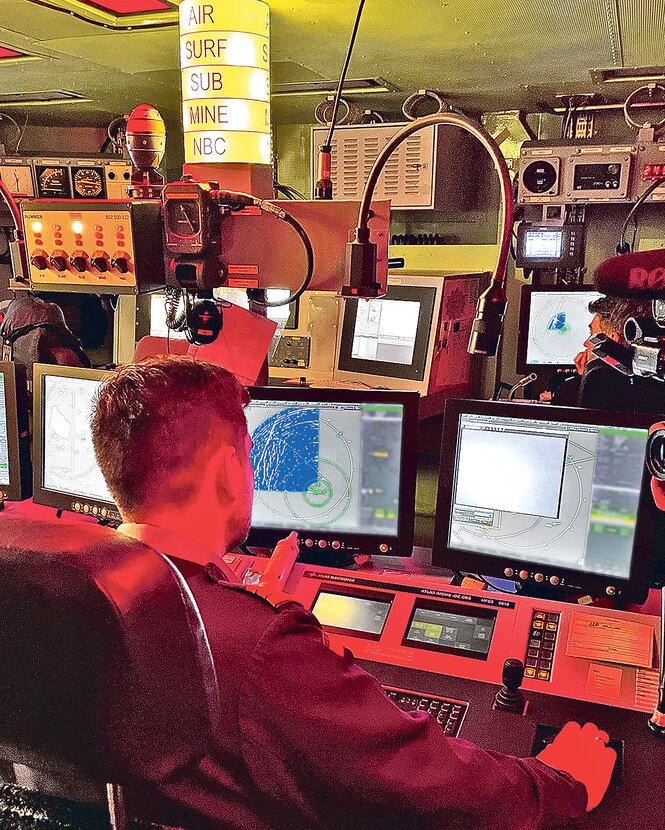
Commander Hirnstein descends from the bridge via a steep metal staircase illuminated only by a few red tubes. “Restricted Area” reads a sign on one door—this is the operations center, classified as secret. It is rare for journalists to gain access here. In the gloomy chamber below the bridge, sonar and radar screens, along with sensors for electromagnetic radiation, glow.
The depths to which the equipment can operate and the range of its capabilities are secrets kept from potentially hostile forces.
Then comes the “Seefuchs.” Men and women aboard hoist the underwater drone overboard, letting it glide into the water. The orange data cable unwinds from the spool—seven meters, eight meters—until the craft is barely visible. Only a small wake at the water’s surface reveals the direction the “Seefuchs” has descended.
Simultaneously, the drone is operated from the operations center below deck. To the right of Commander Hirnstein sits the drone operator, whose screen displays the sonar images. Moments later, a yellow fraying line appears on the screen, stretching from left to right: Nord Stream 2.
The reporter questions how difficult it is to monitor such a lengthy pipeline. “Utopian,” comes the response from those in the room. However, the objective is not just to monitor but also to deter, gather intelligence, and foster enhanced international cooperation. This is about showcasing capabilities and preparing for a potential war, a scenario everyone aboard hopes remains simply a simmering tension.
General News – 2