
Astronomical Wonders: Total Eclipses in Spain (2026-2028)
The years 2026 and 2027 will become significant milestones in the world of astronomy for residents and visitors in Spain. During this period, two total solar eclipses will occur within consecutive years, offering a unique opportunity to witness these stunning celestial events. Additionally, 2028 will add to the excitement with a new annular eclipse viewable from the Iberian Peninsula. Experts from the National Geographic Institute (IGN) are already gearing up for these remarkable astral displays.
New Maps for Viewing Eclipses
In preparation for these astronomical events, the IGN is working diligently to create a new series of maps and a comprehensive guide to ensure that the public can fully appreciate the impending eclipses. These maps are available for consultation on the IGN’s website, specifically in a special section dedicated to eclipses here.
A Line-Up of Eclipses: 2026, 2027, and 2028
There are three incredible eclipses to look forward to between 2026 and 2028 . The first is scheduled for August 12, 2026 , when a total solar eclipse will sweep across a diagonal strip of the peninsula from western Asturias to northern Castellón , including parts of the Balearic Islands . This path ensures that numerous spectators will be able to experience complete darkness as the moon obscures the sun.
The second total eclipse, occurring a year later on August 2, 2027 , will glide through the southern part of the peninsula, particularly affecting regions from Cádiz to Almería , with the Malaga coast also included in the shadow path. The final celestial event will take place on January 26, 2028 , featuring an annular eclipse that will primarily impact the southern coastal area of Huelva and extend to the border between Castellón and Valencia .
<img alt="A third of Spain will be completely dark for one or two minutes. The astronomical event of the century is approaching" width="375" height="142" src="https://i.blogs.es/8180f6/spain/375_142.jpeg"/>A Comprehensive Eclipse Guide
The IGN’s new initiative is more than just a map viewer; it serves as a comprehensive guide to ensure every key detail is appreciated during these eclipses. In addition to detailed maps, the guides include animations that visualize the moon’s shadow as it traverses the Earth’s surface. This information is instrumental for both seasoned astronomers and curious onlookers alike.
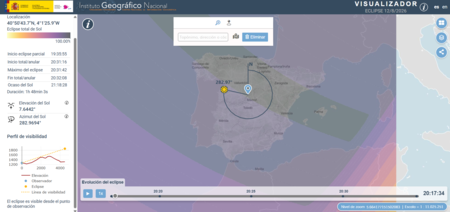
<span>Eclipse visualizer for August 2026. IGN/CNIG.</span>Interactive Eclipse Visualizer
One of the standout features of the new IGN tool is the eclipse visualizer , a dynamic map allowing users to observe the progression of the moon’s shadow as it moves across Spain. This interactive tool provides essential information, such as the start and end times of the eclipse, the totality phase, and maximum eclipse, along with data like the elevation and azimuth of the sun!
Planning for the Eclipses
Though the first eclipse is still over a year away, proper planning is vital to ensure you don’t miss any of these breathtaking moments. Events like these are known to cause significant travel and hotel occupancy spikes, especially since the two total eclipses will fall during the popular summer months of August . Drawing from the experience of recent eclipses, it’s wise to prepare logistics well ahead of time.
Additionally, safety considerations should not be overlooked. The specialized glasses needed to safely observe solar eclipses can run out weeks before the event, so securing a pair in advance is crucial. Remember, glasses used for previous solar events might not meet current safety standards!
In conclusion, these impending solar eclipses present an extraordinary opportunity for astronomical enthusiasts and casual sky-watchers alike. Active engagement and thorough planning will ensure that observers can fully experience the magic of these celestial events as they unfold across Spain . Don’t miss your chance to witness the wonders of the cosmos!