
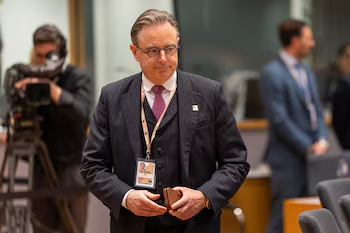
Belgium’s Stance on the EU’s Financial Support for Ukraine
Belgian Governor Bart De Wever expressed serious concerns over the European Union’s proposal to utilize frozen Russian assets for financing Ukraine. During a recent summit attended by European leaders, this idea was decisively ruled out, primarily due to the potential risks it poses to legal certainty. Concerns were raised about possible international lawsuits and jurisdictional conflicts that could arise, guiding Belgium’s strong stance in discussions with the EU Council.
The Joint Loan Agreement
Following extensive discussions that spanned over sixteen hours, an alternative solution emerged. The 27 Member States reached a consensus on a joint loan of 90 billion euros to support Ukraine, financed through shared debt rather than by tapping into frozen Russian assets. This agreement was designed to accommodate the varied sensitivities of both large and small nations, thereby ensuring political and financial unity within the EU. According to De Wever, this strategic move not only sustains support for Kyiv but also protects banking systems and national authorities from unpredictable demands, reinforcing a commitment to international law.
Concerns About Legal Repercussions
The Belgian delegation emphasized the significance of a solid legal framework during the summit, particularly regarding Russian funds held by Euroclear, a financial entity in Brussels. De Wever stated that acting without a robust legal basis could provoke retaliation from Russia, which may lead to the confiscation of European funds under Russian jurisdiction, thereby escalating international litigation scenarios. The uncertainties surrounding potential legal claims were paramount in shaping Belgium’s cautious approach towards financial assistance structures.
Flexibility and Predictability
The joint loan framework allows for flexibility and rapid mobilization of resources while adhering to a legal structure that safeguards the European financial system’s integrity. De Wever underlined that this aid package represents a critical investment in European security, crucial for maintaining regional stability amidst ongoing geopolitical tensions.
Future Prospects for Frozen Assets
While frozen Russian assets currently lack a defined purpose, EU institutions continue to explore legal and political frameworks for their future use to assist in repairing war-induced damages. The desire to eventually allocate these funds for Ukrainian reconstruction remains steadfast in Brussels. However, any modifications will hinge on ongoing conflict developments and diplomatic progress.
Maintaining Market Confidence
The finalized financial support package aims to provide clarity and predictability for markets, reinforcing the EU’s credibility on a global scale. By establishing clear parameters and avoiding hasty legal improvisations, the agreement is poised to adapt to changing circumstances while honoring legal principles. De Wever’s commitment to upholding international legality in extraordinary situations emphasizes the necessity of law as a cornerstone for collective security.
The Belgium-led approach ensures that Euroclear and related state institutions remain shielded from long-term judicial claims, while keeping financial pressure on Russia intact. The summit’s outcome sends a unified message to Moscow, reaffirming the EU’s adherence to legal frameworks and its unified vision for regional stability.