
Understanding Talent and Genius
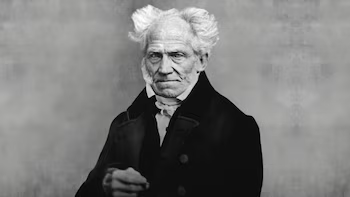
Arthur Schopenhauer profoundly illuminated the difference between talent and genius with his quote: “Talent hits a target that no one else can hit; genius hits a target that no one else can see.” This notion has been echoed through the ages, reflecting on how societies value different forms of human capability.
The Biblical Foundations of Talent
The concept of nurturing one’s talent is not new; it traces back to ancient texts, including the Bible. In a notable parable, a man entrusts his servants with gold coins based on their abilities. While two servants invest and double their profits, the third hides his coin out of fear and is punished upon the master’s return. This story illustrates that possessing talent isn’t sufficient; one must also leverage it effectively.
Schopenhauer’s Perspective on Genius
Talent vs. Genius
Schopenhauer’s exploration in The World as Will and Representation highlights a crucial distinction: talent often seeks money and glory, while genius pursues truth. This enduring idea suggests that while many can execute tasks efficiently, only a few truly innovate or envision what is possible. The capability for pure, disinterested contemplation is inherent to genius—something Schopenhauer argues most individuals lack.
The Misunderstanding of Genius
The genius often faces misunderstanding from their contemporaries. Schopenhauer points to historical figures such as Socrates, who was executed for his ideas, or Giordano Bruno, who was burned for declaring the sun a star. These examples illustrate how revolutionary thinkers are often not recognized in their own time, often leading to isolation or persecution.
Philosophical Echoes in the Works of Others
Kant’s Definition of Genius
Immanuel Kant, another foundational figure in philosophy, described genius as “the talent of producing that for which no fixed rule can be given.” Like Schopenhauer, Kant emphasized creativity as an essential aspect of genius, demonstrating a shared philosophical lineage that seeks to explore human capacity beyond conventional boundaries.
Nietzsche’s Views
Similarly, Friedrich Nietzsche, who revered Schopenhauer in his early years, posited that genius dwells in “a different eye,” not necessarily a superior understanding. This perspective reinforces the idea that genius can transform one’s perception, suggesting that creative vision often diverges from societal norms.
The Implications for Society
Schopenhauer’s idea is a timeless lesson for the modern world. While talent enables individuals to accomplish typical tasks successfully, genius serves as a guiding light for future innovations. Recognizing both capabilities could lead societies toward a more prosperous and creative future, where individuals are encouraged not just to conform, but to innovate and inspire.
Ultimately, Schopenhauer’s insights remain relevant, urging individuals and societies alike to broaden their understanding of human potential. Talent executes the present; genius shapes the future. Recognizing and nurturing both could be the key to unlocking a more innovative and expressive society.