
Intel has long been regarded as a titan in the technology sector, especially within the realm of integrated circuits. However, over the past ten years, the company has experienced a staggering decline, losing one-third of its market value. A significant factor in Intel’s downturn has been its struggled adaptation to the mobile era , losing ground to competitors like ARM , which became the preferred choice for industry giants such as Apple and Microsoft . This shift not only hurt Intel’s market shares but also resulted in the loss of one of its biggest clients: Apple. Despite this troubled history, a potential reconciliation between the two companies could signal a brighter future ahead.
Recent reports indicate that Intel is actively seeking investment from Apple . According to a report from Bloomberg, anonymous sources close to the situation have revealed that Intel has approached Apple with the intention of securing financial backing. While still in the rumor phase, this news has proven to be significant, as evidenced by a 6.4% rise in Intel’s stock following the report. A partnership with Apple could provide Intel the lifeline it desperately needs.
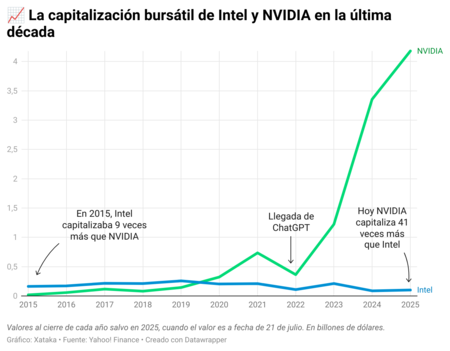
From a market perspective, Intel’s pursuit of an investment from Apple makes a lot of sense. Currently, Intel’s stock hovers around $30 per share, while Apple operates at around $250 per share. Landing Apple as a major client could effectively serve as a financial lifeguard for Intel. This scenario echoes the recent $5 billion investment from Nvidia into Intel, which has given Nvidia a 4% stake in the semiconductor giant.
On the flip side, Apple itself has a vested interest in Intel . In a striking turn of events, the U.S. government acquired a 10% stake in Intel back in August. This move is part of a broader strategy to encourage local manufacturing of technology products and minimize reliance on foreign production in countries such as China and India . Through the implementation of various incentives, including the Chips Law , the U.S. aims to bolster its domestic tech industry. Intel’s capabilities can provide Apple with much-needed support in achieving local manufacturing goals, making them strategically valuable to each other.
Historically, the two companies collaborated very closely. Intel supplied Apple with many of its processors and various internal components for devices like the iPhone . However, the relationship soured when Apple sought greater control of its manufacturing processes, eventually choosing to develop its own ARM-based processors. This in-house manufacturing strategy culminated in Apple’s acquisition of Intel’s modem business for $1 billion . Complicating matters further, this intervention by the government marked the first instance of such a rescue since the 2008 automotive crisis .
Current speculation suggests that the potential partnership wouldn’t simply lead to Intel supplying components to Apple. Rather, according to Bloomberg, Apple may shift to manufacturing components for its devices within Intel’s U.S. facilities. As both companies adapt to evolving market conditions, such a partnership can enhance their competitiveness.
Despite the silence from both Intel and Apple, comments from Tim Cook allude to a desire to see Intel re-emerge as a relevant player in the industry. Cook mentioned that he would find it exciting for Intel to return to prominence, hinting at the cross-investments fueling these discussions. Alongside the capital from the U.S. government and Nvidia, companies like SoftBank have also invested $2 billion in Intel, showing a widespread interest in the firm’s potential recovery.
Looking ahead, Apple has earmarked $600 billion for domestic initiatives over the next four years, further emphasizing its commitment to partnerships that align with U.S. manufacturing goals. Should Intel secure a collaboration with Apple, it could act as a pivotal component in revamping both companies’ fortunes.
Ultimately, the question remains: will these efforts be enough for Intel to reclaim its former glory? The path forward is fraught with challenges, especially with fierce competition from rivals like TSMC , which also have significant plans for U.S. expansions. Only time will tell if Intel can turn the tides in its favor and emerge stronger than before.
Image | Intel