
Huawei Kingdom: The Rise of a Giant
For years, the iPhone was the best-selling mobile phone in China amid fierce competition from Asian manufacturers like Xiaomi, Huawei, OPPO, and Vivo. These brands have worked diligently to craft products that rival or even surpass the iPhone in various critical areas, such as camera quality. However, the landscape of mobile phone sales in China has changed.
Market Dynamics: A New Rivalry
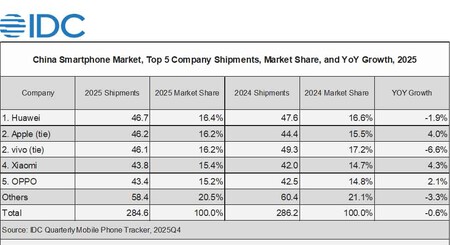
Again, king. Huawei has maintained its position as the top smartphone seller in China for over two years. As of 2025, despite experiencing a 1.9% decline in annual growth, Huawei still holds a slight edge over Apple, with a market share of 16.4% compared to Apple’s 16.2%. Meanwhile, Apple has seen a 4% growth year-on-year, thanks to the positive reception of the iPhone 17 series. Interestingly, Apple has surpassed Samsung globally, claiming the title of the world’s leading smartphone manufacturer while standing second in China.
Close Contenders
- Huawei: 16.4% market share
- Apple: 16.2% market share
- Vivo: 16.2% market share
- Xiaomi: 15.4% market share
- OPPO: 15.2% market share
These minimal differences in market share spell continuous shifts in positions for 2026, clearly indicating that no manufacturer can claim uninterrupted dominance in the fiercely competitive landscape of Chinese smartphones.
The Huawei Strategy: Adapting to Challenges
The Huawei case. Unlike its competitors, who collaborate closely with Qualcomm for premium chipsets, Huawei has adapted by developing its own processors in partnership with SMIC. Additionally, the company has created a software ecosystem that operates independently of Android, fundamentally altering its supply chain. This shift has allowed Huawei to strengthen its foothold in the domestic market, where the absence of Google services is less of a constraint.
Changing Perceptions of Chinese Phones
The surprise. For a long time, Chinese smartphones were perceived as inferior to Western models in terms of long-term software support and multimedia capabilities. Yet, the narrative has begun to shift. Today, Chinese manufacturers are gaining ground in hardware quality.
Strengths of Chinese Brands
- Exceptional battery life
- Highly competitive camera technology
- Superior hardware configurations
- Focus on European market expansion
The Global Landscape Ahead
Not so fast. While the Asian market offers insights into the evolving dynamics among tech giants, global leadership remains contested primarily between Apple and Samsung. Xiaomi accounts for 13% of the global share, while Vivo and OPPO have stagnated at around 8% since 2023.
Looking ahead, consultancies like Counterpoint predict a year of moderation and fragile growth in 2026. The impending price hike due to DRAM and NAND memory shortages will significantly impact the market. Organizations that efficiently manage these challenges may emerge as winners in upcoming years.
In conclusion, while Huawei asserts its dominance in China, Apple continues to thrive globally. Both brands demonstrate the complexities of the mobile phone ecosystem and indicate that the competition is far from over.