
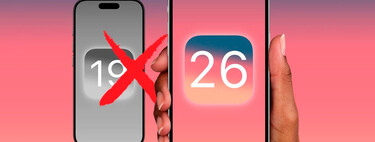
Delayed Anticipation: Apple’s New Siri Targeted for Spring 2026
We have news regarding the much-anticipated new Siri. Unfortunately, it’s not good news. Apple is targeting spring 2026 for the launch of its new assistant, aiming to include it as part of the update to iOS 26.4 , according to sources from Bloomberg.
This delay aligns perfectly with a recent Wall Street Journal interview with Craig Federighi and Greg Joswiak, where they admitted that Apple is well aware it is falling behind in the AI race, leaving the company hoping that its proposition will eventually succeed in the long term.
Promises Unfulfilled. It’s been just a year since Apple unveiled its focus on Apple Intelligence. They spoke of an integration of Siri into the system unlike anything we’ve seen before: an assistant capable of understanding every aspect of iOS, with advanced contextual understanding and integration with every native app.
Initially, the final rollout was slated for autumn 2024, but delays piled up to an unsustainable point.
iOS 26 as a Significant Leap. At WWDC 25, Apple showcased iOS 26, which represents one of the most significant visual identity changes in Apple’s operating systems, now much more unified. Alongside it, they finally introduced some AI features relevant to everyday use; however, these functionalities hardly extend beyond text translation, filters for calls, and some improvements in Genmoji generation within Image Playground .
After nearly a year of delays, Apple seemed to clarify its AI philosophy: working towards local applications, but aiming to function similarly to its rivals.
Increased Delays. Following the presentation of iOS 26, which included some AI features but no word on the new Siri, the question arose: What is happening with it? Federighi’s responses were nothing if not revealing, showcasing precisely where Apple stands at the moment.
- [Joanna Stern] “Siri is not better than its competition,” [Craig Federighi] “True, but it will be, it’s our mission.”
- [Greg Joswiak] “It would be disappointing to launch something that doesn’t meet our quality standards.”
- [Craig Federighi] “This is a new technology, and honestly, no one is doing it right at the moment.”
Joswiak, Apple’s software leader, justified their roadmap around a key point: the company wants its AI to be discreet , enabling users to accomplish tasks on their phones without even realizing they are using Apple Intelligence. They don’t intend to have a dedicated app for it, unlike what is available for Gemini or ChatGPT . The issue? Google has achieved this goal a long time ago.
Apple’s Rivals Are Gaining Ground. Despite Apple claiming the AI for mobile is still immature, the landscape is witnessing a surge in capabilities. Devices like the Google Pixel and the Samsung Galaxy S25 Ultra exemplify this advancement. A crucial distinction needs to be made between Gemini as an integrated app within the system and Gemini Nano as a language model. On a device like the S25 Ultra, you can:
- Real-time translation of calls without realizing AI is at work.
- Automatically eliminate background noise from a video without the user knowing AI is intervening.
- Transcribe a voice recording with a single click, without launching additional apps.
- When receiving a call, automatically detect whether it’s spam, without any AI prompts.
Indeed, Google, although its approach is not as local, can seamlessly integrate Gemini into the system so that its functionalities operate as native features, allowing users to remain oblivious to which functions leverage AI and which do not.
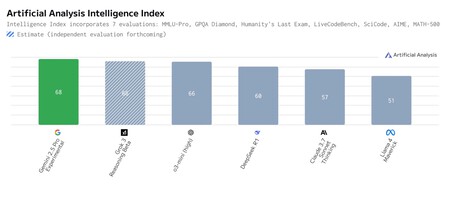
Apple needs to outperform Gemini in AI. This won’t be easy.
So Far, Apple Has Not Shown Adequate Capability. During Apple’s presentation, its stock dropped by 1.5%. Expectations were high, but the presentation clearly communicated that Apple is not surpassing any of its direct competitors and relegating the advanced functionalities of AI to third parties like OpenAI .
As all eyes are now on 2026, the pressure on Apple is mounting. Its main competitor, Google Gemini , has reached a high maturity level, surpassing benchmarks against Grok 3 , o3-mini , DeepSeek R1 , Claude 3 , and Llama 4 . To regain trust, Apple needs tangible results, not promises.
Image | Xataka
In Xataka | We have discovered something concerning in AI models: if the problem is too challenging, they give up too quickly.