
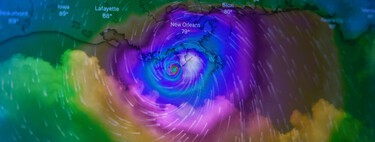
Atlantic Hurricane Season: A Mid-September Update
September 10 is a date marked in the calendars of hurricane-expert meteorologists. It is the date on which the Atlantic hurricane season usually achieves its peak of activity. However, the decreasing trend in the average activity of Atlantic cyclones should not deceive us: there is still a significant season ahead.
We Enter the Final Stretch. According to experts at the National Hurricane Center (NHC), 60% of hurricane activity occurs after this peak. This means that despite having passed the midpoint of the season—running from June 1 to November 30—we still have more than half of the cyclonic activity to anticipate.
NHC meteorologists also remind us that the activity during this part of the season tends to have a profound impact on the western zone of the North Atlantic, which is especially vulnerable as hurricanes often make landfall in North America and the Caribbean .
<img alt="Google has demonstrated with its AI that the prediction of storms and hurricanes is outdated. This is how your new model works" width="375" height="142" src="https://i.blogs.es/ccf2f5/brian-mcgowan-kkyxiwvljbg-unsplash/375_142.jpeg"/>A Quiet Season. When the Atlantic hurricane season began in June, experts predicted a relatively quiet season, but the data shows an even greater meekness than expected. To evaluate the intensity of a hurricane season, various metrics can be used, such as the number of named storms, the number of hurricanes, the total number of days with active hurricanes, and the Accumulated Cyclonic Energy (ACE).
According to data from the Tropical Meteorology Project at Colorado State University (CSU), the expected ACE at this time of year would typically be 55.8, yet the observed ACE is only 39. This signifies a 30.1% decrease compared to initial expectations.
Erin, the Disruptive Force. Additionally, much of this energy can be attributed to a single hurricane, Erin . Erin’s ACE is reported at 32.2, representing approximately 82.6% of the overall activity for the season.
What’s Happening. The expectation that this season would be less intense than previous years aligns with observed data: while the Atlantic temperatures have not surged to the extreme levels seen in recent years, the El Niño oscillation remains in a state of indecision, impacting hurricane formation.
A recent study led by CSU’s meteorologist Philip Klotzbach identifies three primary factors that contribute to this observed trend. First, the Atlantic is described as “dry and stable.” The second factor is a pronounced channel in the high troposphere , which increases vertical wind shear—one of the two critical components, alongside ocean temperatures, in hurricane formation. Lastly, a descending air movement over Africa is impacting rainfall patterns, leading to fewer intense waves in the region.
What Can We Expect. Klotzbach’s team shares insights with NHC experts, suggesting that the hurricane activity may pick up again this month. “We anticipate that the season will resume its intensity, as large-scale conditions seem to become more tropical and favorable for cyclones later in September,” they explained in their report.
Thus, they advise against changing seasonal forecasts. The initial estimates by the Tropical Meteorology Project of the CSU indicated that the total ACE by the end of the season would reach 122.5 . However, if we consider the current data of 39 and apply the estimated 60% activity typically seen at this time of year, we could expect an ACE around 100 . The upcoming months will be crucial in determining whether this trend solidifies or if we will see an uptick in seasonal activity.
Notably, methods for mitigating hurricane impact are evolving. Increasingly, researchers and engineers are exploring innovative solutions, such as oyster and coral walls , to bolster coastal defenses against future storms.
As we navigate through the remaining months of the hurricane season, both hurricane preparedness and community awareness remain vital. Understanding potential risks and arming ourselves with information about forecasts can be critically important for regions susceptible to these natural phenomena.