
The Artificial Island of Loch Bhorgastail
In various rural areas of Scotland, an ancient tradition has persevered for centuries. When droughts or storms cause the water levels of lakes to drop, curious rows of stones and dark wood emerge, often referred to by locals as “the traces of the ancients.” Initially believed to be natural formations, archaeologists have since uncovered that many of these remnants are actually hidden human constructions submerged for millennia.
Discovery of an Ancient Man-Made Structure
In early May, an extraordinary event occurred: a small artificial island, believed to have been constructed over five thousand years ago, resurfaced in Loch Bhorgastail on the Isle of Lewis. This groundbreaking discovery challenges existing theories about prehistoric human activity in the area. The island, built primarily of wood, branches, and stone, predates even the renowned Stonehenge. This find signifies a remarkable achievement during the Neolithic period, a time when communities were just beginning to engage in large collective projects.
Re-evaluating Neolithic Societies
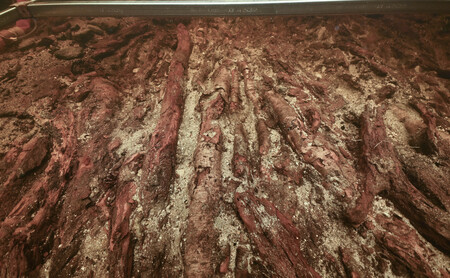
This finding not only compels us to reconsider the ages of Scottish “crannogs” but also sheds light on the organizational capabilities of societies that successfully transformed aquatic landscapes long before Europe’s most famous megalithic structures emerged. Archaeologists revealed that the islet initially served as a circular wooden platform, about 23 meters in diameter, layered over time with branches and stone. The dating of this construction places its origins between 3800 and 3300 BC, convincing researchers that these Neolithic communities had far greater skills and planning capacity than previously assumed.
The wooden platform of the crannog, below the waterline
A Submerged Path and Community Life
Among the most striking elements among the debris was the discovery of a submerged stone road linking the island to the lake’s shore. This infrastructure indicates that the site served as a commonly used space for entire communities rather than merely a symbolic structure. The extent of alterations and ongoing usage from the Neolithic to the Iron Age further emphasizes the site’s significance over generations.
Archeological Findings Indicating Organized Societies
Hundreds of Neolithic ceramic fragments were also unearthed around the island. Many of these artifacts still have remnants of food, suggesting activities related to community gatherings and potential ritual banquets. The labor-intensive effort needed to create such an artificial island indicates the presence of societies much more organized and coordinated than previously imagined.
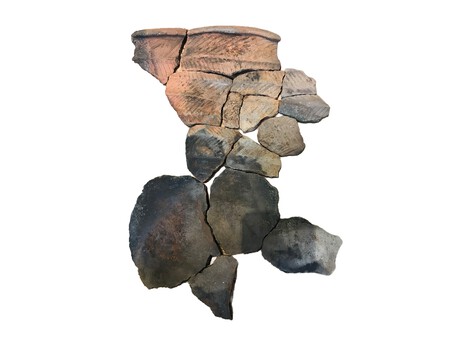
Fragments of a Neolithic pot found near the crannog
New Techniques for Underwater Exploration
Significantly, the success of this excavation is attributed to new techniques developed for studying areas in shallow water—historically considered challenging for archaeological research. Researchers combined drones, waterproof cameras, and stereophotogrammetry systems, enabling the creation of continuous 3D models both above and below the water’s surface.
The Future of Scottish Archaeology
This remarkable discovery raises the possibility that hundreds of similar crannogs exist across Scotland’s lakes, potentially dating back much further than the Iron Age or medieval periods traditionally ascribed to them. The investigation into these submerged landscapes could reveal more artificial platforms and human activity remnants from an unexpectedly early epoch in European history.
A Reassessment of Neolithic Complexity
Ultimately, the Loch Bhorgastail discovery reshapes our understanding of Neolithic societies in Britain. Building a wooden and stone island required sophisticated planning, material transport, and large-scale social cooperation. All this innovation occurred over five thousand years ago, well before some of the world’s most iconic prehistoric monuments were constructed.
Image Credit: University of Southampton