

Tax Cuts and Economic Investment: A Detailed Analysis
In a striking report released on Monday, a significant figure from the Trump administration alongside two economists has unveiled findings that highlight how business tax cuts stimulate economic investment . This timely report comes as Republicans in Congress intensely debate the implications of these tax policies in their upcoming legislative agenda.
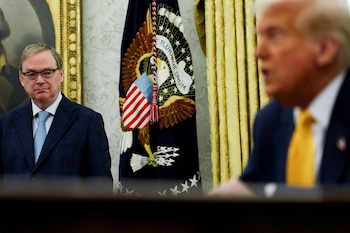
The report, compiled for the National Bureau of Economic Research, features Kevin Hassett , the director of the White House Council of Economic Advisors. He argues that the corporate tax cuts enacted as part of the Republican-backed 2017 tax legislation resulted in substantial increases in investment, even years after the legislation’s implementation. Hassett contends that the boosts in investment were greater than previously estimated, reinforcing the arguments for tax cuts as a catalyst for economic growth.
The Legislative Landscape
As the Trump White House and Senate Republicans grapple with budget allocations, the implications of this report could play a crucial role in shaping future tax proposals. Recently, the House Republicans passed a bill that earmarked trillions of dollars for households, aligning, at least partially, with Trump’s campaign promises regarding the elimination of taxes on tips and overtime pay. However, to lower the overall cost of this legislation, the House bill also scaled back some of the tax breaks for corporations established under the 2017 law, particularly targeting incentives for research and development spending.
Many Senate Republicans have indicated their desire for these corporate tax measures to be made permanent in the revised version of their bill. Although the fate of these tax incentives remains uncertain, Hassett’s report, co-authored by Jonathan Hartley and Joshua Rauh from Stanford’s Hoover Institution, could bolster their advocacy for maintaining these provisions.
A Closer Look at the Findings
According to the report, companies make investment decisions based on associated costs for new equipment, buildings, or intangible assets. The authors interpret the 2017 tax law as a “natural experiment” illustrating how these costs affect investment decisions, allowing for a comparative analysis of how firms reacted to different tax incentives. The findings reveal that a one percentage point reduction in the cost of capital led to investment increases of up to 3% , significantly exceeding previous estimates.
Hartley noted, “This is a huge battle right now in the Senate,” referring to the ongoing efforts to solidify tax provisions that would enable companies to immediately deduct the total cost of certain investments. “At the end of the day, it’s the business provisions that stimulate economic growth the most, and the report substantiates that notion.”
Critics and Perceptions
Despite the compelling nature of Hassett’s report, it is unlikely to resolve the heated discourse surrounding the effects of corporate tax cuts. Several economists have pointed out the report’s limitations. Alan J. Auerbach, an economist at UC Berkeley, noted that while the study reinforces the idea that tax incentives mobilize capital to sectors with favorable tax breaks, it fails to quantify the overall increase in business investment conclusively. He remarked that if the investment supply were fixed, the policy could merely redistribute funds among sectors, indicating the necessity for more comprehensive analysis.
Auerbach also criticized the current bill for allocating inadequate funds to stimulate economic growth, despite its massive price tag of $2.4 trillion . He lamented, “I’d like to see a tax bill more focused on these types of policies, but that’s politics.” Meanwhile, critics from the Democratic Party have denounced the proposed tax legislation for its severe cuts to Medicaid and projected fiscal costs that could escalate beyond $5 trillion when considering potential extensions and interest costs.
On the other side, Kyle Pomerleau from the American Enterprise Institute agreed with Hassett’s premise that the 2017 tax law spurred investment but cautioned about potential methodological flaws in the analysis. Gabriel Isaac Chodorow-Reich from Harvard University, while acknowledging that the report confirms a growing economic consensus that corporate tax cuts enhance investment, emphasized that such measures might disproportionately benefit owners and exacerbate income inequality.
Ultimately, Chodorow-Reich stated, “I’m not arguing that it’s infallible public policy. What legislators must do is weigh the benefits against the costs. Understanding both sides is crucial, and having an emerging consensus on the benefits is helpful.”
In conclusion, the ongoing discourse surrounding corporate tax cuts and their impact on economic investment is characterized by a blend of supporting arguments, critical assessments, and political maneuvering, underscoring the complexity of tax policy in shaping the economic landscape.