
Groundbreaking Football Matches: Humanoid Robots Take Center Stage in Beijing
In an extraordinary display of technological prowess , four university teams competed with fully autonomous humanoid robots in football matches in Beijing. Unlike traditional games, these matches featured teams of robots playing 3 against 3 , all without any human intervention. This fascinating event highlighted the advances in robotics and artificial intelligence, even as the androids stumbled, fell, and some were taken off the field on stretchers.
The Reality Behind the Show
While the match may have resembled an animated children’s training session, each robot operated completely independently using sophisticated AI technology . These cutting-edge humanoids, approximately the size of a child, utilized advanced visual sensors, allowing them to detect the ball and navigate the pitch with surprising agility. Despite some tumbles, most of the robots managed to rise on their own, although a few required human assistance.
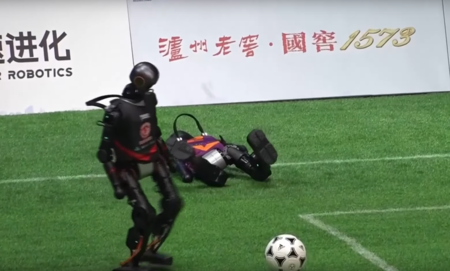
Image: The Independent
The final match saw Thu Robotics from Tsinghua University triumph over the Mountain Team from the Agricultural University of China, concluding with a score of 5 to 3 . The clumsy antics of the robots can be enjoyed in available video footage , showcasing a variety of unexpected plays and falls throughout the match.
The Technological Context
China has made a significant investment in the realm of humanoid robotics, aligning it with its national technological strategy . According to forecasts from Morgan Stanley , the Chinese robotics market is projected to grow by 23% annually , ultimately reaching around $108 billion by 2028 compared to its current value of $47 billion. By 2050, it’s anticipated that China will deploy around 302.3 million humanoid robots — a figure that dwarfs the estimated 77.7 million for the United States.
Robotics in the Field of Sport
Sport has increasingly become a critical testing ground for robotic innovation. Earlier this year, 21 humanoid robots participated in a half marathon in Beijing, although only six completed the race. This football tournament serves as a precursor to the World Humanoid Robots Games scheduled for August 2025 , which will take place in Beijing, featuring 11 robotic sports , including football, athletics, and gymnastics.
Insights From the Ground
Cheng Hao, founder of Booster Robotics , which supplied robots for the event, remarked on the importance of sports competitions in accelerating the development of both algorithms and integrated hardware-software systems. He emphasized safety as a primary concern, stating, “In the future, we could organize matches between robots and humans, which necessitates that we ensure robots are completely safe.” The goal is to build trust among spectators by showcasing authentic interactions between androids and humans .
The Irony of Football
Interestingly, while the Chinese national football team ranks 94th according to FIFA, their robotic counterparts displayed an ability to entertain and score goals. Perhaps one day, these robots could fulfill the tactical vision of notable managers like Pep Guardiola , who has faced criticism for advocating a style of play that lacks creativity. As one commentator noted, “Now we have robots,” underlining the irony of technology outperforming human athletes in some respects.
Conclusion
The analysis reveals that China’s commitment to embodied AI surpasses that of any other nation. This investment in robotics technology could grant the country a significant edge as other countries, including the United States, begin to prioritize and invest in this evolving field. The recent matches in Beijing not only served as entertainment but also reflected a broader commitment to integrating robotics into various facets of life, potentially transforming the future landscape of sports.
Cover image | The Independent