
| IN SHORT |
|
The recent discovery concerning LUCA, the Last Universal Common Ancestor, has caused a significant upheaval in the scientific community. Revealed to be far older than previously believed, LUCA pushes the limits of our understanding of the origins of life on Earth. With an estimated dating of 4.2 billion years , this finding opens new perspectives on the evolution of living organisms and the speed at which life might have emerged after the formation of our planet. These revelations prompt a rethinking of the mechanisms that led to the biological diversity we observe today.
The Universal Ancestor: At the Roots of All Terrestrial Life
LUCA represents the convergence point of the genealogical tree of all living beings on Earth. This microscopic organism is the precursor to today’s biodiversity, from bacteria to mammals and plants. Research led by Edmund Moody at the University of Bristol suggests that this common ancestor existed around 4.2 billion years ago . This figure challenges earlier estimates by 400 million years, questioning our certainties about the timeline for life’s emergence.
The new timeline implies that life could have appeared almost immediately after Earth’s formation, which occurred around 4.5 billion years ago . This hypothesis strengthens the idea that the emergence of life might be a rapid process under favorable conditions. Despite its simplicity, LUCA already possessed essential cellular mechanisms that laid the groundwork for subsequent evolution. This procaryotic cell, albeit elemental, had developed abilities for reproduction and interaction with its environment, paving the way for the biological diversity we observe today.
Scientific Methods to Trace Back in Time
To reassess the dating of LUCA, scientists employed advanced phylogenetic analysis techniques. This method allows for tracing evolutionary history by analyzing genetic mutations accumulated over generations. DNA mutations act as a molecular clock , providing a tool to measure the elapsed time since species diverged.
Researchers developed a sophisticated mathematical model to evaluate the mutation accumulation rate. By comparing the DNA sequences of various organisms, they could identify preserved common genes throughout evolution. This analysis enabled them to trace back to LUCA and estimate its age with unprecedented precision. This methodology represents a significant advance in our ability to explore the origins of life, confirming the crucial role of modern genetics in illuminating time periods where no direct fossils are available.
“They hardly feel pain: a rare genetic mutation gives them extraordinary abilities”
Portrait of a Pioneer of Terrestrial Life
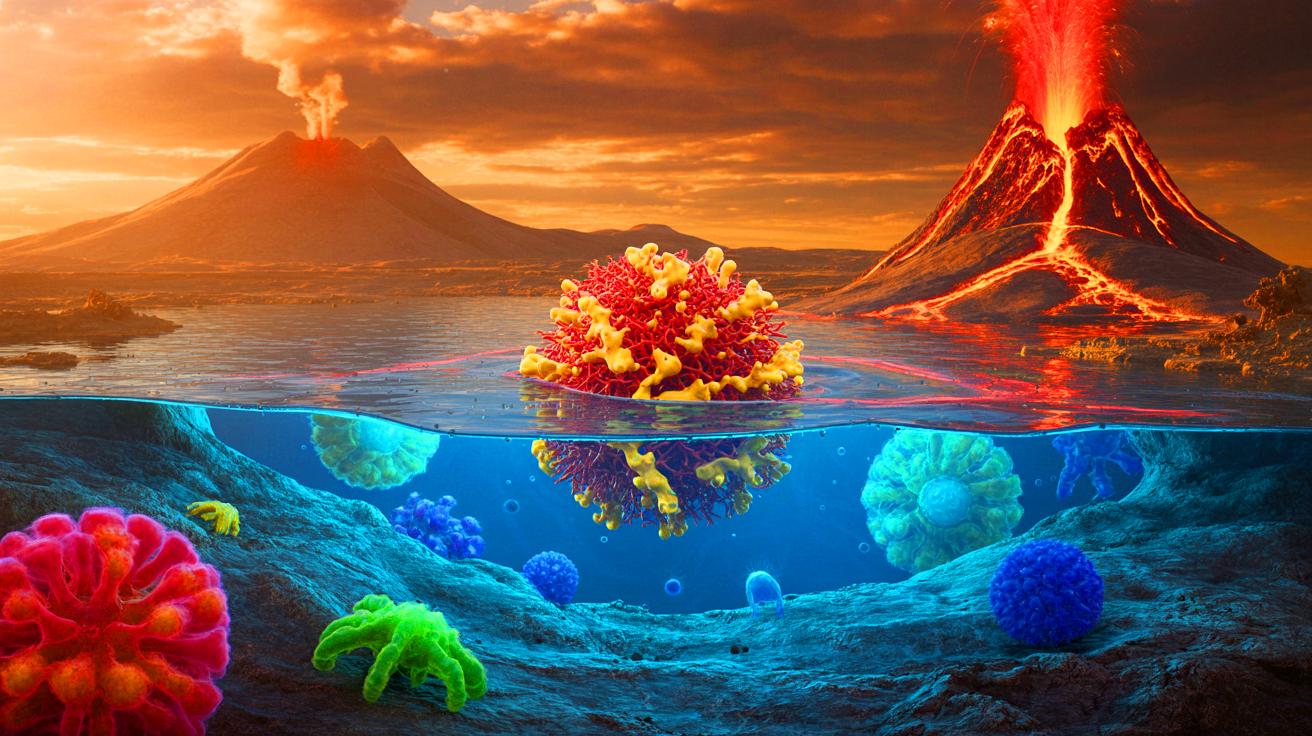
Although fossils of LUCA are not available, scientists have been able to reconstruct its portrait by studying traits common to all current living beings. LUCA likely evolved in an extreme aquatic environment rich in metals and various chemical substances. These conditions, characterized by high temperatures and strong pressures, were typical of primitive Earth.
Despite its apparent simplicity, LUCA possessed sophisticated biochemical mechanisms. Research suggests that it had a rudimentary immune system, protecting it from primitive viruses. This defensive capability showcases significant biological complexity even at this remote time.
LUCA participated in early biogeochemical cycles, with its metabolic waste nourishing other microorganisms. This early interdependence among organisms laid the foundations for future biodiversity. The discovery of LUCA’s true age raises numerous questions regarding the emergence of this first cell and the precise conditions that enabled the organization of inert matter into living systems.
Perspectives and Open Questions on the Evolution of Life
The dating of LUCA at 4.2 billion years provides a new perspective on life’s evolution. It encourages a re-examination of the conditions necessary for life’s emergence and an exploration of the mechanisms that allowed a primitive cell to diversify into complex life forms. Understanding how this single cell led to the extraordinary diversity of life remains a significant challenge for scientists.
Future research could reveal more about the processes that enabled such diversification and about potential similar conditions on other planets. What is the probability that comparable mechanisms have occurred elsewhere in the universe, and can we hope to discover extraterrestrial life forms based on these same fundamental principles?
The author relied on artificial intelligence to enhance this article.