
Spain has just marked a milestone in the European defense industry. Airbus is over assembly of the first SIRTAP, a New Generation Tactical Drone designed and manufactured in the country. This isn’t merely a technical advance; it’s a declaration of Spain’s intentions to play a significant role in the development of strategic technologies .
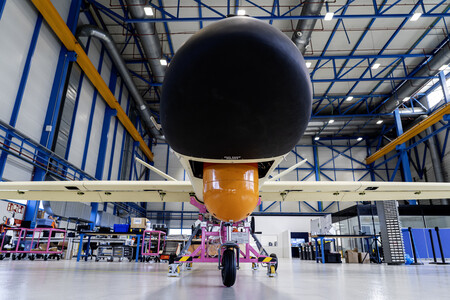
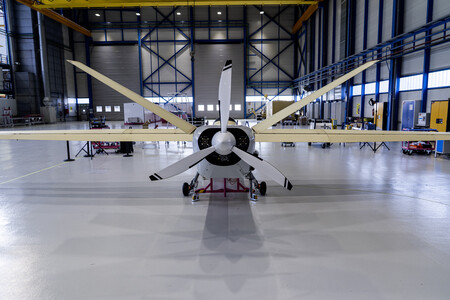
The SIRTAP has been meticulously assembled at the facilities of Airbus Defense and Space in Getafe. The purchase was formalized by the Ministry of Defense in November 2023, with a request for nine complete systems comprising 27 aircraft and nine ground control stations. This is where the first prototype has taken shape, and now it is preparing to commence an Earth Test Campaign.
The Spanish Focus on Tactical Drones
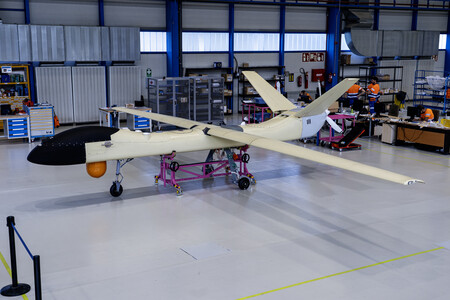
The tests, which will evaluate both the structure and the main components of the system along with the software, are set to extend over the coming months. The goal is to have the drone ready for its first flight before the end of 2025 at the CEUS DEL INTA trial center in Huelva.
According to Airbus, the new drone has been engineered to withstand extreme conditions : it can operate in temperatures ranging from -40 °C to 50 °C, land on unpaved surfaces, and maintain flight for over 20 hours continuously. It boasts an operational ceiling exceeding 21,000 feet (6,400 meters), making it an ideal platform for long-distance reconnaissance and surveillance missions.
What Airbus aims to achieve with SIRTAP goes beyond basic reconnaissance. The drone has been envisioned as a modular platform capable of adapting to various missions: it can monitor convoys from the air, serve as an armed escort, detect electronic signals, participate in electronic warfare operations, or control borders in hostile environments. Moreover, it can be deployed in emergency scenarios, such as search and rescue missions or providing fire support.
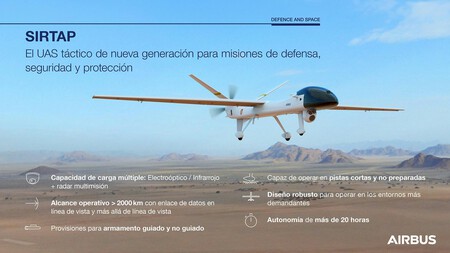
One of the standout features of SIRTAP is that it has been designed without components subject to ITAR restrictions, which, according to Airbus, facilitates its export to international markets. This characteristic, coupled with its modular architecture , opens the door for future versions tailored for various environments, such as a naval variant or complete weapons integration. Notably, the system is also designed to interoperate with existing command and control networks.
SIRTAP enters a segment already occupied by several established players . Drones such as the Tactical Heron, known for its capability to carry multiple payloads simultaneously, and the Bayraktar TB2, celebrated for its effective real combat missions boasting over one million operational flight hours. You also find the Falco Xplorer, which grants over 24-hour autonomy at flight ceilings above 30,000 feet.
In light of this landscape, the Airbus drone presents a compelling combination: free from ITAR restrictions, with a modular architecture, interoperability with European systems, and operability in extreme conditions. Its emphasis is not solely on performance metrics but rather on offering an adaptable platform that is easily exportable and has the potential to evolve into naval or armed versions. While it has yet to take its first flight, its roadmap positions it as a significant player to consider in the market.
Images | Airbus Media Center
In Xataka | Otto aims to revolutionize with the Phantom 3500: eliminating windows for passengers and introducing immersive screen technology.