
OpenAI CEO Sam Altman participated in a recent event organized by The Indian Express. During this insightful interview, he addressed pressing concerns about the energy consumption associated with training AI models like ChatGPT. Notably, he argued that many discussions surrounding this topic are disproportionately unfair.
Training Humans Also Consumes a Lot
When asked about ChatGPT’s energy consumption, Altman took a moment before making a thought-provoking comparison. He emphasized the energy expenditures required not just for AI, but for human training as well. “One of the things that is always unfair in this comparison is that it talks about how much energy it takes to train an AI model compared to what it costs a human to perform an inference query,” he stated.
But it also takes a lot of energy to train a human. It takes about 20 years of life and all the food you eat during that time before you become intelligent. Not only that, it took the widespread evolution of the hundred billion people who have lived and learned to understand science and more to create you.
Altman suggested that a fair comparison would involve looking at the energy needed for ChatGPT to respond to a query after its model is trained, which he believes has already become energy-efficient.
Training vs. Inference Costs
Altman’s comparison raises an important distinction: training and inference costs. Learning, whether in humans or AI, requires significant resources, but the subsequent application of that knowledge—known as inference—has far lower energy demands. While acknowledging that AI does consume substantial energy during training, Altman argued that once trained, models like ChatGPT become highly efficient in their inference phase.
Although he has claimed that the energy consumption during inference is minimal, he has not yet provided definitive evidence to substantiate this claim.
The Water Consumption Controversy
Altman also touched upon the contentious issue of water consumption in large AI data centers. He noted that although water usage was problematic in the past—particularly with evaporative cooling methods—current practices have evolved significantly. “We don’t do that anymore,” he asserted, declaring accusations that “ChatGPT uses 17 gallons per query” as “totally false” and “crazy.” Still, a lack of official data from AI companies complicates the issue.
What is the True Consumption of AI?
Despite ongoing debates, concrete data on AI’s energy and water consumption is still elusive. Some studies have exaggerated figures, and in the U.S., there is no legislation mandating transparency in this area, leaving the discourse largely speculative.
Increasing Efficiency in Models and Data Centers
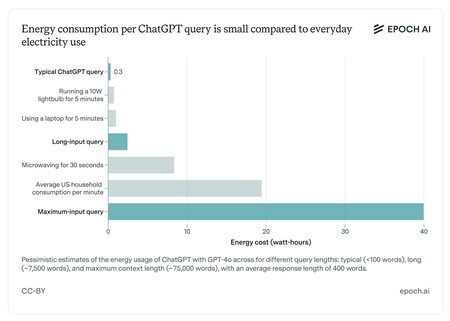
One promising study from Epoch AI in February 2025 suggested that AI’s actual energy consumption is significantly less than often claimed. The findings implied that AI models have become more efficient over time, supported by advancements in chips and cooling systems. While the energy demands of data centers are substantial, advances in technology suggest a trend toward reduced consumption.
The dialogue on energy use in AI continues to evolve, warranting more nuanced evaluations as both technology and societal expectations progress.