
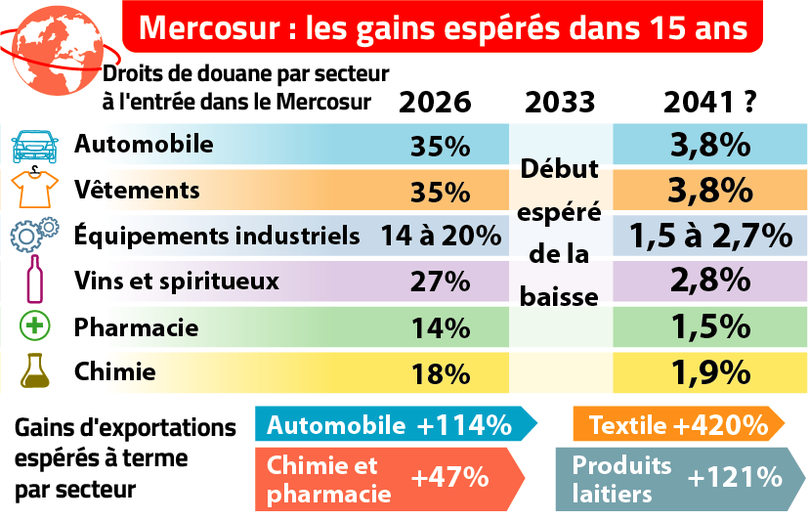
According to economists, the free trade treaty with Mercosur is expected to be beneficial for France, particularly in sectors such as viticulture, dairy, aeronautics, and pharmaceuticals. This agreement, once seen as a potential threat by agricultural sectors, is gaining attention as a possible boon for certain French industries.
Economic Prospects and Challenges
The free trade agreement sparked discussions last weekend in Paraguay among European and South American leaders. While some farmers express concern about an influx of low-quality imports, experts suggest that the overall trade balance could tilt positively for France, albeit modestly. Ratification timelines are still uncertain as European lawmakers have forwarded the treaty to the European Court of Justice for legal evaluation, adding another layer of complexity to its implementation.
No Immediate Gains Expected
Predictions indicate that significant benefits from the treaty may not materialize until 2041, contributing only about 0.05% to European GDP. The gradual reduction of customs duties—expected to drop by 91% over fifteen years—will likely hinder immediate large-scale trade relations. South America currently ranks as Europe’s 10th largest trading partner, trailing behind regions such as Turkey in trade volume.
Interestingly, German industries, particularly in automobiles and chemicals, are poised to capture approximately two-thirds of the commercial gains, leaving farmers and cattle breeders at a disadvantage. With increased beef imports from Mercosur, they could face an estimated annual market loss of 1.2%.
Sectors Set to Flourish
1. New Opportunities for Wine Growers
The opening of the Mercosur market presents potential opportunities for wine producers. An anonymous executive from a regional AOP noted the competitive edge that could emerge as customs duties decrease from 17-35% to zero. This change may significantly drop the price of French wines, allowing them to compete against Chilean and Uruguayan wines more effectively.
Jean-Marie Fabre, the President of the National Federation of Independent Winegrowers, acknowledges this potential but urges for a balanced agreement that does not compromise France’s food sovereignty. The expected market gain for the wine sector is projected at €3 billion annually by 2040, reflecting the necessity for long-term strategies to secure a foothold in these emerging markets.
2. Cheese and Dairy Products
The cheese industry also stands to benefit from the treaty, with expectations for exports to South America to increase by 121%. The sector boasts 344 recognized cheese appellations, and the possibility of circumventing U.S. tariffs adds another layer of appeal. However, small producers may struggle to compete against larger corporations, which could dominate the market.
Delphine Carles, manager of a historic Roquefort cheese factory, voiced skepticism about the readiness of South American consumers for certain French cheese varieties, expressing concerns about the effects on smaller producers.
3. Chemistry and Pharmaceuticals: A Potential Win
The chemistry and pharmaceutical sectors are positioned to gain from the agreement as well. As per Mathieu Ourliac, a regional business leader, these industries could respond effectively to new market demands. However, the anticipated gains are expected to be marginal, especially with safeguard clauses in place to protect local industries.
Ourliac emphasized the need for a balanced approach to labor costs and regulatory standards, highlighting the ongoing struggle between agricultural and industrial interests within France.
Conclusion
While the Mercosur Free Trade Agreement has its advantages, especially for specific sectors, the broader implications for French agriculture and industrial balance remain uncertain. The ongoing discussions and evaluations will ultimately shape its future, as France navigates the complexities of international trade in an ever-evolving economic landscape.