
Activism Against Homophobic Remarks in Colombian Politics
In a recent public dialogue, presidential candidate Abelardo de La Espriella made controversial remarks while imitating fellow candidate Juan Daniel Oviedo. His comments, which suggested that Oviedo’s sexual orientation could be altered like a trivial preference, ignited outrage among various social sectors and sparked discussions on homophobia in politics.
Discriminatory Remarks and Public Outrage
De La Espriella stated, “What I don’t like about Juan Daniel, crazy, it’s screwed that he fixes it,” implying that Oviedo’s identity is something that can and should be corrected. This statement was met with backlash from numerous activists and commentators who labeled it as discriminatory, asserting that it diminished Oviedo’s sexual orientation by equating it to a minor issue.
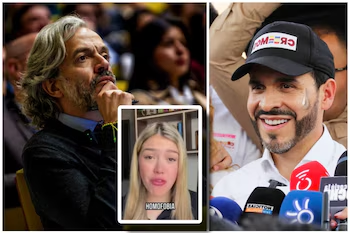
Political journalist and activist Laura Camila Vargas emphasized the seriousness of the situation. She criticized De La Espriella’s remarks as a blatant example of homophobia and insisted that such statements cannot be dismissed as innocent gestures. She said, “This is indeed homophobia, and we are going to explain it with plasticine because the abelardists want to pass it off as an innocent gesture.”
The Harm of Ridicule and Cultural Frameworks
Vargas elaborated on how imitating Oviedo’s voice and mocking his identity creates a culture of ridicule that undermines the legitimacy of LGBTI communities. She stated, “The problem is what he says: ‘My thing is resolved. What I don’t like about Juan Daniel is screwed, let him fix it.’ We are not stupid.”
By trivializing sexual orientation, De La Espriella reinforces harmful stereotypes and perpetuates a cultural framework that views homosexuality as a deviation or affliction. Vargas noted, “Wearing or not wearing stockings would be something that can be corrected, but Oviedo’s sexual orientation would be a permanent problem. This contrast presents homosexuality as something negative or defective.”
Legal Protections and the Role of Leadership
Vargas highlighted the risks of such rhetoric, particularly from a potential future president. In Colombia, the Constitution and the Constitutional Court’s jurisprudence clearly protect sexual orientation against discrimination, affirming that LGBTI individuals have equal rights. De La Espriella’s comments, therefore, represent a significant deviation from these established norms, indicating a willingness to appeal to conservative sectors by resorting to open homophobia.
The Impact on Democratic Debate
The implications of De La Espriella’s remarks extend beyond mere insults; they challenge the fundamental principles of democracy. Vargas pointed out that Colombia is home to a diverse population, including hundreds of thousands of LGBTI citizens who face various forms of violence and discrimination. It is vital for political leaders to acknowledge and address this reality rather than trivialize it.
“A presidential candidate should represent that democratic standard, not mock it,” Vargas asserted, urging that homophobic remarks undermine the legitimacy of representation in a democratic society.
Conclusion: Recognizing Diversity in Leadership
The remarks made by Abelardo de La Espriella signify a larger issue within the Colombian political landscape. The manner in which future leaders understand, respect, and embrace diversity will profoundly impact the country’s democratic trajectory. It is crucial for those in positions of power to acknowledge the worth of all citizens, regardless of their identity or sexual orientation, and to foster an inclusive environment that prioritizes equality and respect.