
The Bering Strait: A Historical Gateway Between the United States and Russia
The Bering Strait , a narrow expanse of water, separates Alaska in the United States from Chukotka in Russia. This remarkable geographical feature spans barely 80 kilometers, yet it offers an intriguing opportunity during winter months. When the sea freezes, it’s possible, though illegal , to walk between the two countries via the Diomedes Islands. Each tiny island, Big Diomede and Little Diomede , belongs to Russia and the U.S. respectively. This frozen pathway has sparked discussions about creating an official corridor that would physically connect these two nations.
Trump and the Twists of Diplomacy
In the complex landscape of modern geopolitics, U.S. President Donald Trump has emerged as a pivotal figure in two significant international issues: the ongoing conflict in Palestine and the war between Russia and Ukraine . Whether seeking to bolster his chances for a Nobel Peace Prize or genuinely aiming for resolution, Trump has effectively positioned the U.S. as a vital player in both arenas. His communications with Ukraine’s Zelensky and Russia’s Putin are frequent and strategic, further stirring curiosity about renewed interest in physically linking the U.S. and Russia.
A Tunnel Vision: The Proposed Project
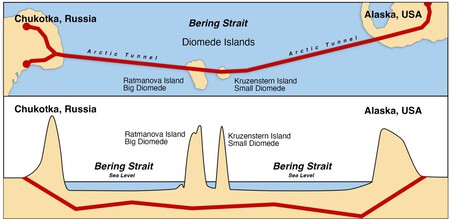
Following one of Trump’s discussions with Putin, Kirill Dmitriev , the director of the Russian Direct Investment Fund (RDIF) , publicly proposed a dramatic infrastructure project: a 112-kilometer railway tunnel beneath the Bering Strait and the Diomedes Islands. This proposal was not born out of thin air; it builds on years of feasibility studies aimed at understanding the potential for such a monumental undertaking.
150 Years of Intrigue
The concept of connecting the United States and Russia through a tunnel is by no means novel. Dmitriev referenced plans dating back to the 19th century , highlighting how various proposals have emerged over the last 150 years. The first notable proposal occurred in 1890 when an American governor suggested a railroad that would link both continents. Despite losing momentum due to geopolitical upheavals like the Russian Revolution and World War I , the notion of a tunnel or bridge linking Alaska and Chukotka has endured.
Modern Solutions to Complex Problems
The feasibility of constructing a tunnel is complicated, particularly when considering economic challenges. Dmitriev estimates that if traditional building methods were employed, costs could skyrocket to over $65 billion . However, he suggests that innovative technology from Elon Musk’s Boring Company could drastically reduce this expense to below $8 billion . Musk’s company has gained international attention for its rapid tunneling techniques, making the seemingly impossible project appear plausible.
Challenges Await
Despite innovative plans and substantial funding, the project faces formidable obstacles. The proposed tunnel would be twice as long as the Eurotunnel connecting France and England and needs to be excavated through challenging geological conditions. The Bering Strait lies within the Pacific Ring of Fire , a region known for seismic activity . Moreover, the construction would require going 45 meters beneath the seabed to withstand ocean currents.

Additionally, the tunnel’s construction sites would be situated in areas of permafrost that are subject to climate change. As Arctic temperatures rise, the ground is already showing signs of instability, as evidenced by issues concerning Alaska’s Trans-Alaska Pipeline . The structural integrity of a tunnel resting on such unstable soil could be seriously compromised.
A Vision for the Future
It remains to be seen whether plans for a Bering Strait tunnel will materialize or fall into the queue of delayed ambitions. Challenges ranging from national security to environmental hazards and infrastructural feasibility are daunting hurdles that need to be addressed. Nonetheless, the prospect of connecting the U.S. and Russia through a tunnel ignites imaginations and speaks to an enduring hope for collaborative solutions, even amidst geopolitical tensions. The future of this ambitious venture could redefine not just geography but also international relations between the two nations.