
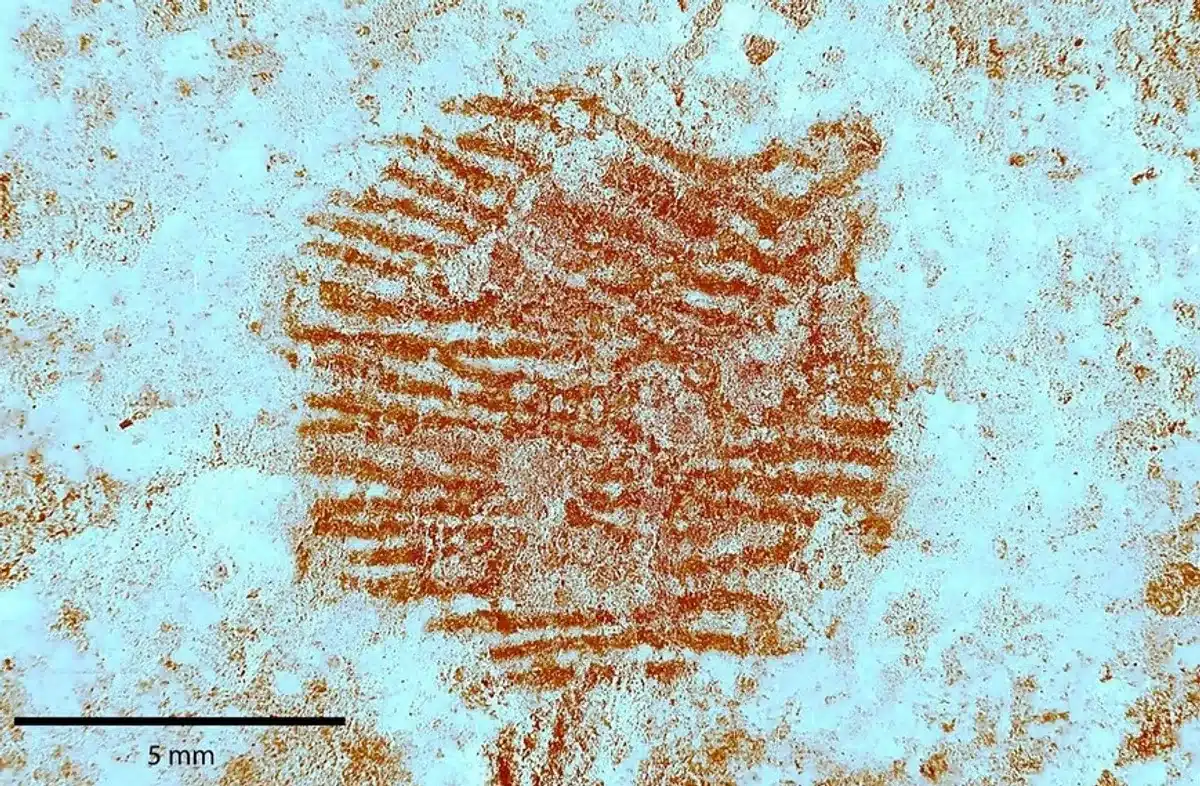
A simple pebble, a hint of red ochre, and a fingerprint. These elements have rekindled a fascinating debate about the symbolic capabilities of our long-gone relatives: the Neanderthals. Unearthed from the San Lázaro rock shelter in the heart of Spain, this stone may represent one of the oldest known expressions of human-like facial features… and it doesn’t belong to our species.
A 43,000-Year-Old Impression
The star of this discovery is an unassuming rock, found in a sediment layer that dates back approximately 43,000 years . Its surface bears a circular red mark , clearly made by a finger, from which researchers have extracted a complete Neanderthal fingerprint—the most detailed ever identified. Although a previous partial print was found in Germany, this one is remarkable for its completeness and intriguing context.
This red spot is no accidental stain. It was intentionally applied with a finger dipped in pigment, as stated in a study published in Archaeological and Anthropological Sciences. Analysis reveals that the pebble shows no signs of practical use; it is neither a tool nor a functional object, but most likely a symbolic artifact .
Art or an Illusion of the Mind?
What makes this pebble particularly captivating is its striking resemblance to a human face. The red mark —presumably applied carefully—overlaps natural depressions in the stone that evoke two eyes, a mouth, and a sort of nose. Together, they create a familiar, almost expressive silhouette.
Herein lies a phenomenon well-known to psychologists: facial pareidolia , the tendency we have to recognize faces where none truly exist—in clouds, rocks, or even electrical outlets.
The big question posed by researchers is this: did this Neanderthal perceive the “face” in the stone and choose to emphasize it through this symbolic act? Or was it merely a serendipitous coincidence, interpreted retrospectively by our modern eyes?
The authors refrain from making a definitive conclusion but highlight that the possibility of symbolic intent cannot be dismissed. If confirmed, it dramatically alters our understanding of the cognitive capabilities of Homo neanderthalensis .
Neanderthals: The Forgotten Artists
For decades, Neanderthals have been relegated to the status of brutish beings, devoid of language or imagination. However, this stereotype has been dismantled over recent years. We now know they buried their dead, used pigments, wore ornaments, and likely mastered certain forms of complex communication.
This pebble could, therefore, fit into a broader spectrum of documented symbolic behaviors , which have too often been solely attributed to our species. The notion that Neanderthals may have also felt the need to express ideas, represent forms, or even play with symbols is becoming increasingly difficult to refute.
A Nuanced Worldview
Ultimately, this small object invites us to reevaluate our perception of Neanderthals. No, they were not mere crude hominids; they were beings with emotions, acute perceptions, and perhaps even a sense of beauty or mystery.
The existence of this fingerprint— a direct testament to human contact, dating back tens of thousands of years—intensifies the unsettling intimacy we share with them. The act it captures may be nothing more than a finger pressing ochre onto a stone. Yet, it embodies intention, curiosity, and perhaps even a desire to mark or signify.
What if that intention was artistic? What if this action equated to an early brushstroke or a prehistoric emoji etched into the annals of time?
In Conclusion
A pebble discovered in Spain features a complete Neanderthal fingerprint combined with a red ochre stain.
The non-utilitarian object appears to have been deliberately painted, and its shape resembles a human face.
Researchers mention the pareidolia phenomenon to explain this interpretation, while also leaving open the hypothesis of voluntary symbolic representation.
This discovery strengthens the idea that Neanderthals shared with us a form of abstract, possibly artistic thought.