

Labor Reform on the Brink: A Double-Edged Sword for Colombia
In Colombia, the labor reform is poised to become law, a development that is sparking celebration among labor sectors and the national government. On Thursday, June 19, representative Alirio Uribe of the Pacto Histórico party, warned of potential pitfalls that could derail this significant legislative effort. Despite progress in the legislative agenda, Uribe cautioned that the journey is far from over.
Uribe spoke to La W, underscoring that while the Colombian Senate approved the labor reform on Tuesday, the future of the proposal remains precarious due to inherent risks associated with voting on the conciliation process. The representative emphasized that the crucial voting session is scheduled for Friday, June 20, which will determine the fate of the labor reform.
The Risks Ahead
The timing of the voting could be jeopardized by various factors, such as insufficient quorum or sudden interruptions during the Senate session, which could risk the approval of the labor reform. Uribe used a poignant metaphor, stating, “I want to tell the country that the bread can burn at the oven’s door,” underlining how close Congress is to finalizing this process, while simultaneously expressing the looming threat of losing everything at the last moment.
Moreover, Uribe pointed out the impending risk that over forty legislative projects in Colombia could be neglected due to procedural holdups. His concerns extend to a comprehensive range of projects currently in their fourth debate, all facing the same threats that endanger the labor reform. For Uribe, the instability of the quorum and the potential for hasty decisions in the plenary setting present significant obstacles during the legislative session’s waning days.
The Popular Consultation Debate
Uribe’s comments also extended to the popular consultation that was promoted by the government. He voiced his support for this initiative while also criticizing the recent action taken by the Council of State, which suspended the decree that called for this participatory mechanism. The congressman stressed that the consultation is vital for advancing the labor reform, emphasizing that without its initiation, revival, and approval, the initiative aiming to modernize Colombia’s labor regime would falter.
Directly confronting the judicial body’s role, Uribe stated, “The Council of State does not have the authority to review the constitutionality of the decree… That responsibility lies with the Constitutional Court. I am reading the Political Constitution of Colombia.” His emphatic remarks reflect the mounting tensions within the Congress as the crucial legislative day approaches, where both the labor reform and numerous other projects face the risk of being shelved if they cannot navigate the remaining parliamentary procedures.
The Final Document of the Labor Reform
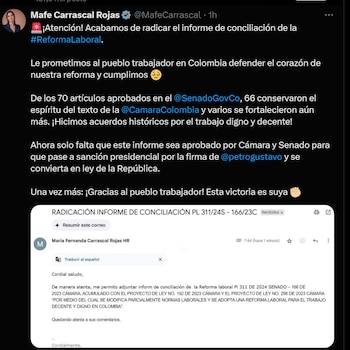
The final document of the labor reform in Colombia includes provisions that directly affect formal workers, digital platforms, and traditional informal sectors such as community mothers and food handlers in the PAE. The conciliation report has already been filed, and the labor reform is just one step away from becoming law, pending final voting in both the Senate and the House of Representatives before June 20.
Representative María Fernanda Carrascal of the Pacto Histórico announced the submission of the conciliation report on the morning of June 19. She detailed that the final text, which incorporates the majority of the points proposed by President Gustavo Petro, will be debated and voted on in both congressional chambers. If approved, it will then be sent to the president for sanction and promulgation as law.
Carrascal emphasized the significance of this moment, stating, “We have made historic agreements for dignified and decent work! Now we just need this report to be approved by the House and Senate so that it can be sent for presidential sanction by the signing of Gustavo Petro, making it law of the Republic. Once again: Thank you to the working people! This victory is yours.” The resolution of this labor initiative serves as a reflective point for Colombian society as it confronts complex labor issues and economic challenges ahead.