
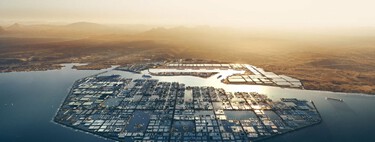
The American rapper Alioune Badara Thiam, better known as Akon , announced in 2020 his goal of building a $6 billion megacity in Senegal. This city, inspired by Wakanda , the fictional Central African country created by Stan Lee and Jack Kirby, was intended to be the home of the superhero Black Panther.
The proposal promised to alter the urban and economic landscape of Senegal, aiming to attract investments and tourism. However, similar to other ambitious projects, “Akon City” faced a reduction in its estimated investment from $6 billion to just a fraction of that amount, ultimately resulting in a couple of buildings in a remote rural area southeast of the capital, Dakar.
Akon City: Wakanda in Real Life
Akon gained fame as a successful rapper during the early 2000s. Although most of his life was spent in the United States, he originates from Senegal. This connection fueled his dream of bringing an innovative project to his home country.
The artist envisioned a futuristic megacity modeled after Wakanda as represented in Marvel’s comics and movies. The project was officially named Akon City.
Despite the risk of the proposal becoming merely an artistic eccentricity, Akon garnered institutional support from the Senegalese government. Minister of Tourism Alioune Sarr advocated for the project, stating, “For all those coming from America, Europe, or anywhere wanting to visit Africa, we want Senegal to be their first stop,” during the project announcement.

Akon City
Akon expressed his desire for the city’s buildings to resemble authentic African sculptures found in traditional villages, as noted by the Washington Post. This vision included unique skyscrapers with sinuous designs that would set the city apart.
According to the project’s website, Akon City was set to have distinct thematic zones— educational, healthcare, technological , and entertainment —featuring hospitals, sports stadiums, film studios, research labs, and universities.
How Will It Be Funded?
Funding for the project was planned to come from a combination of state and private investments, as well as a cryptocurrency called Akoin that was intended to be created to support the city’s development.
In the beginning, the Senegalese government provided 800 hectares of coastal land for the urban project in Mbodiène, a village situated about 100 kilometers southeast of Dakar .
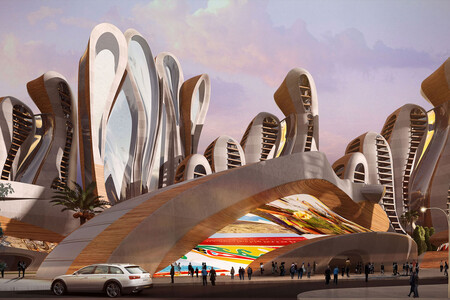
Akon City Entertainment District
However, much like other mega-projects with far larger budgets, Akon soon recognized that $6 billion was an immense sum to amass. By 2024, the investment expectations were adjusted to a more feasible $1 billion plan.
The Akoin cryptocurrency began trading on the Bitget exchange platform at $0.15 on November 19, 2020, but plummeted to $0.003 by December 11, revealing a lack of widespread support for the project.
As reported by Bloomberg, the present state of the project has shown that there are no roads, homes, or electrical grids on the promised land. So far, the only constructions funded by Akon include a youth center and a basketball court. There remains no trace of the futuristic buildings envisioned for Akon City.
The Future of the Land
The project’s fate was encapsulated by Serigne Mamadou Mboup , director of the Senegal Tourism Development Agency, who stated to the BBC that “The Akon City project no longer exists. Fortunately, an agreement has been reached between Sapco and the businessman Alioune Badara Thiam. What is now being prepared with us is a realistic project, which Sapco will fully support.” Akon himself acknowledged that he took on all responsibility for the mismanagement of the project.
While Senegal has regained 90% of the land initially allocated for Akon City, plans will continue with Akon to develop sports and civil facilities for the 2026 Youth Olympic Games in Dakar. However, the long-anticipated vision of a Senegalese Wakanda remains shelved for the time being.