
The Electric Vehicle Market Explosion: Global Trends and Chinese Dominance
In 2022, a staggering 17.29 million electric cars and plug-in hybrids were sold globally, a number that reflects the growing trend towards sustainable transportation. However, if we were to narrow this down to the top ten brands , it would be striking to discover that six of these prominent players hail from China. This revelation marks a significant shift in the automotive industry, hinting at a power transition that might redefine the future of electric vehicles (EVs).
The Status Quo: Electric vs. Plug-in Hybrid
According to data from EV volumes, electric vehicles accounted for 62.5% of total electrified vehicles sold globally last year, while plug-in hybrids (PHEVs) represented 37.5% . This is a noticeable decline from the previous year when EVs dominated with 69.3% . This reflects evolving preferences and market dynamics, shaping the future of vehicle sales.
Why does an electric car have less autonomy than announced?
The Leading Brands
At the forefront of this transformation is BYD , capturing an impressive 22.2% market share. Following far behind is Tesla , which holds 10.3% of the market. Collectively, traditional Western automakers like BMW, Volkswagen, and Mercedes-Benz account for less than 8% , emphasizing the dominance of their Chinese counterparts. The market share distribution can be visually represented by the following graph provided by Rest of the World:
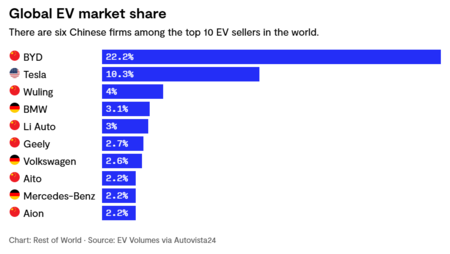
<span>Global Electric Car market share | Image: Rest of the World</span>China’s Market Influence
It is entirely reasonable for China to lead this market. So far this year, the country has registered 58.1% of electric vehicle sales and an astounding 70.1% of plug-in hybrids. In stark contrast, the United States, the second-largest market, accounts for 9.5% and 5.2% respectively, while Spain trails with a mere 1.6% in hybrids.
China’s success in capturing the electric vehicle market can be attributed to several factors. The Chinese government is heavily investing in incentives that promote EV adoption while also focusing on the infrastructure necessary to support this shift. Additionally, China plays a vital role in the global supply chain for electric vehicles, manufacturing around 80% of lithium-ion batteries—an essential component for any electric vehicle.
<img alt="We tried the eye of God with which BYD wants to break the market: autonomous driving for a €9,000 car" width="375" height="142" src="https://i.blogs.es/ab5a5a/captura-de-pantalla-2025-07-01-a-las-15.48.41/375_142.png"/>Global Expansion: The Next Frontier
BYD’s rapid ascension has made it the pinnacle of electric car sales, surpassing Tesla in many categories. Currently, Tesla is the third-best-selling brand in China, with a market share of 5.9% . This sets the stage for what might be an inevitable global expansion for these Chinese manufacturers. BYD aims to derive 50% of its sales from markets outside China, including establishing factories in Hungary and Turkey . Other brands like Omoda , Jaecoo , and MG are also making significant inroads into international markets.
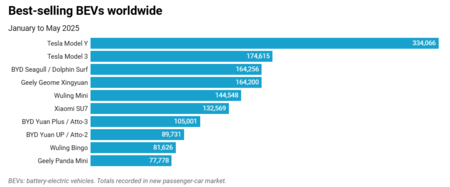
<span>Best-selling electric cars worldwide | Image: Highway24</span>Current Sales Rankings
Although Tesla remains the best-selling brand overall, the competitive dynamics have shifted significantly. Tesla’s Model 3 and Model Y are performing exceptionally well, maintaining their status as the most popular battery electric vehicles (BEVs) of the year. However, nearly all other top-selling electric cars are from Chinese manufacturers like BYD , Geely , and even tech giant Xiaomi , whose Xiaomi Su7 has impressively landed as the sixth best-selling electric car of the year.
As the global market continues to evolve, these trends illustrate a clear movement towards innovation, sustainability, and international collaboration in the automotive sector. The rise of Chinese electric vehicle manufacturers is indicative of their strong manufacturing capabilities and understanding of the consumer landscape, and it sets the stage for a dynamic future in the automotive industry.