
Investigating the universe beyond our Solar System often leads to more questions than answers. The search for exoplanets has yielded findings that challenge our understanding of celestial bodies. For instance, the Kepler Space Telescope unveiled Kepler-16b, a planet orbiting two suns, reminiscent of the fictional world of Star Wars’ Tatooine. Meanwhile, the James Webb Telescope discovered a boiling lava world that didn’t align with theoretical predictions.
In a remarkable observation, NASA’s Hubble Space Telescope captured an event so exceptional that it turned the notion of a disappearing planet on its head, revealing a case of violent cosmic phenomena instead.
From Assumption to Revelation: The Cosmic Discovery
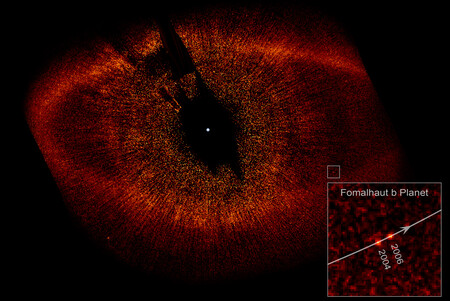
Initially, astronomers detected a bright point of light, believing it to be a dust-covered planet reflecting starlight. However, as the light source vanished and another emerged nearby, the research team realized they were witnessing not planets but incandescent debris from violent collisions, as published in Science.
A Planetesimal Collision That Changes Everything
Over time, the observations revealed two powerful impacts generating significant dust within the same planetary system. This constituted a rare chance to deepen our understanding of planet formation and their material composition. Astrophysicist Jason Wang from Northwestern University highlighted that this marks the first instance of a planetesimal collision observed beyond our solar system. The findings could provide valuable insights into planetary structure and asteroid composition, which is crucial for planetary defense initiatives like the DART mission.
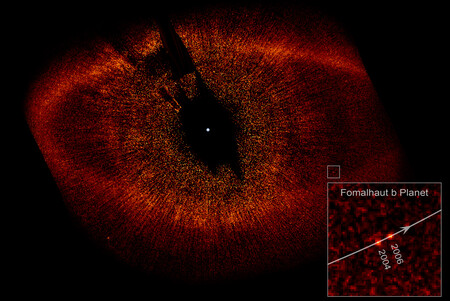
By NASA, ESA, P. Kalas, J. Graham, E. Chiang, E. Kite (University of California, Berkeley), M. Clampin (NASA Goddard Space Flight Center), M. Fitzgerald (Lawrence Livermore National Laboratory), and K. Stapelfeldt and J. Krist (NASA Jet Propulsion Laboratory)
The collisions occurred in the planetary system surrounding the larger-than-sun star Fomalhaut, located about 25 light-years from Earth in the constellation Pisces Austrinus. The dust belt surrounding Fomalhaut is extensive, providing a rich area for astronomical research.
Planet or Dust Cloud? Reinterpreting Cosmic Observations
Fomalhaut b was detected back in 2008, initially thought to be a planet or an expanding dust cloud from past collisions. In 2023, Hubble’s observations revealed an intriguing twist: the original bright light source had vanished, replaced by another object slightly shifted in location. Wang emphasized, “They assumed the bright light was Fomalhaut b, but they got a surprise.”
“We assumed the bright light was Fomalhaut b because it was the known source of the system. By carefully comparing the new images with the old ones, we realized that it couldn’t be the same source. It was exciting, but also perplexing.”
This led the team to rename the original object Fomalhaut cs1, concluding that it was not a planet, but a dispersing dust cloud from a collision. They identified the new source as Fomalhaut cs2, further confirming their suspicions about the nature of these observations.
Implying a Need for Caution Among Exoplanet Hunters
Fomalhaut cs1 may no longer exist, but the research team is keen on monitoring cs2, which could yield critical data on the dynamics of collisions within young planetary systems. Both Hubble and the James Webb Space Telescope will be utilized in these observations, particularly to ascertain the size and composition of the dust grains, including potential water or ice content.
This discovery serves as a cautionary note for exoplanet hunters: large clouds of dust can easily mimic the signatures of a real planet by reflecting light from their stars. Kalas stresses, “What we learned from studying cs1 is that a large dust cloud can masquerade as a planet for many years.” As observational technology advances, differentiating between genuine planets and temporary dust clouds will become increasingly crucial for our understanding of the cosmos.