

The Dawn of a New Era: China’s Revolutionary Electromagnetic Cannon
At the end of May, a group of scientists from the Popular Liberation Army of China made waves in the realm of military technology. They announced an astonishing breakthrough: the world’s first coilgun without capacitors, an electromagnetic cannon capable of firing at an astonishing rate of 3,000 shots per minute . Just weeks later, Japan fired back with its own innovation, a rail cannon mounted on the deck of the JS Asuka ship. This marked a new chapter in the high-tech arms race .
China’s ambition didn’t stop there as they poised themselves with an even more sci-fi-like projectile . With the development of a new experimental electromagnetic cannon design , or railgun, China is asserting itself in the high-tech arms landscape . This innovation promises to double its firepower and significantly enhance its range, positioning itself as a formidable force in naval warfare.
The backbone of this groundbreaking technology lies in an unprecedented architecture. The new design incorporates a superposition of two cross-shaped railguns within a single unit, creating what can be described as a “ double linear engine .” This pioneering configuration features independent yet coordinated magnetic fields that maximize efficiency.
Under the leadership of Professor Lyu Qingoo at the University of Engineering of the EPL Army in Shijiazhuang, the development team is addressing a key limitation encountered in existing designs: the challenge of generating sufficient energy without damaging the system. Higher currents often lead to severe damage as metal components, such as the U-shaped conductors, can melt or be torn apart by magnetic forces, rendering traditional railgun models ineffective.
The innovation of the X-system allows for simultaneous action between the two railguns without mutual interference of their magnetic fields, achieved through their perpendicular orientation. Such an approach aims to resolve the critical barrier currently faced by electromagnetic weapons, ensuring both resilience and improved performance.
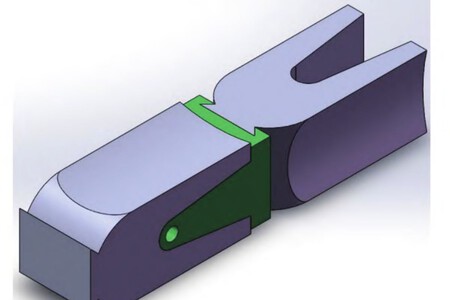
The double armor design for the X-railgun
This adaptation transforms the electromagnetic railgun, initially mounted on the Haiyangshan ship since 2018 and limited to launching 15 kg projectiles , into a more robust platform that aims to accelerate 60 kg projectiles to Mach 7 . This upgrade signifies that targets can be hit up to 400 kilometers away in just six minutes, boasting an impact force surpassing Mach 4.
The implications of this development are significant. By enabling a redefinition of how long-range artillery can be utilized, this technology allows for precise strikes against naval targets, critical infrastructures, or aerial positions in tactical depth. The new capabilities raise the stakes in warfare vulnerability and response times.
Moreover, the autonomous energy circuit for each cannon serves to avoid thermal saturation and short-circuits —issues that plagued many Western railgun programs. For instance, even the United States has officially abandoned its naval railgun due to costs and complexities while Japan remains stuck on low-caliber prototypes. In stark contrast, China’s unwavering resolve positions it ahead in the quest for advanced weapon systems.
The design patent for the “X-shaped armor” has already been registered in China, establishing it as the first documented attempt to stack electromagnetic cannons in a vertical cross configuration. Nonetheless, technical hurdles remain. For instance, the proximity effect , where neighboring electric currents can disrupt their flow, threatens to compromise system stability and efficiency during operational use.
The effects of accumulated heat, rail wear, and precise synchronization during actual firing events remain unknown. While tests in operational settings have yet to be conducted, the potential of this system could redefine electromagnetic artillery . It offers a vision of weaponry that operates without traditional gunpowder or explosives yet possesses a hypersonic impact force rivaling that of the most advanced cruise missiles in the market today.

Beyond technical advancements, the development of this electromagnetic weapon fundamentally acts as a geopolitical message . It illustrates China’s commitment to not only keeping pace but also leading in next-generation armaments , signaling to global powers that the nation is willing to innovate where others have faltered.
China’s strategic approach, merging innovation with practical engineering, contrasts sharply with the Western skepticism surrounding high-risk military projects. Should the X-railgun transition from concept to deployment, it will serve as an unprecedented strategic tool —swift, precise, cost-effective, and incredibly challenging to intercept.
Image | Handout, Picryl Pla Army Engineering University
In this fast-evolving landscape, the advancements made by China could have profound implications for global military strategies. The arrival of such technologies not only enriches China’s naval capabilities but may also alter alliances, tactics, and doctrines in warfare for years to come.