
Chinese Startup Moonshot Defies Expectations with Kimi K2 Thinking
A Chinese startup named Moonshot has recently unveiled its revolutionary AI model, Kimi K2 Thinking, boasting a staggering one trillion parameters. This groundbreaking model has accomplished what many deemed impossible: outpacing leading proprietary models from giants like OpenAI, Google, and Anthropic. This breakthrough prompts a reevaluation of the competitive landscape between open-source models and their proprietary counterparts.
A Game Changer in AI Architecture
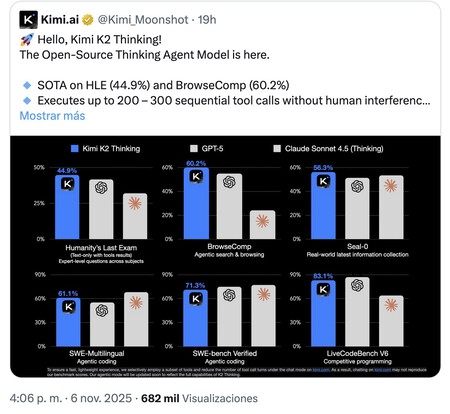
Previously announced in July under the name Kimi K2, this latest iteration features an impressive 32 billion active parameters using Mixture of Experts architecture. This design enables Kimi K2 Thinking to execute between 200 and 300 sequential calls autonomously, enhancing its ability to manage complex tasks with unprecedented reliability. Most notably, it has reportedly surpassed models such as GPT-5 and Claude Sonnet 4.5 in various performance tests while remaining significantly more affordable.
Remarkable Benchmarks Achieved
Moonshot’s Kimi K2 Thinking has already made strides in several significant benchmarks:
- It scored 44.9% in Humanity’s Last Exam, a test of general knowledge.
- In BrowserComp, it achieved an impressive 60.2%, which evaluates agent-based browsing capabilities.
- The model is nearing Claude’s performance in the SWE software development test and excelled in the LiveCodeBench v6 evaluation.
Despite trailing slightly behind other western rivals in some tests, the results are nothing short of spectacular.
Unmatched Performance in Agentic Tasks
Further evaluations by Artificial Analysis revealed Kimi K2 Thinking’s dominance in agentic tasks, such as acting as a customer service agent. It scored an impressive 93%, significantly surpassing competitors like GPT-5, which only reached 87%. This demonstrates Kimi K2’s practical superiority in real-world applications.
Budget-Friendly AI Solution
One of the compelling aspects of Kimi K2 Thinking is its cost-effectiveness. The financial outlay for training the model was merely $4.6 million, which is trivial compared to the estimated $500 million needed for models like GPT-5. The API usage is also economically viable, priced at $0.6 per million tokens in and $2.5 per million tokens out. In comparison, GPT-5 Chat costs $1.25 for a similar input and $3 for output.
Technological Specifications
Kimi K2 employs INT4 quantization to boost efficiency while preserving output quality. Its context window, which indicates the amount of data handled per prompt, is 256k, a modest yet noteworthy figure for large models. Users can even access the model locally, given they possess sufficient hardware, as Kimi K2 requires around 594 GB of storage to function optimally.
Backing from Alibaba
While independent, Moonshot benefits from substantial financial support from Alibaba, establishing the tech giant as a formidable player in the AI realm. Alibaba is not just content with creating its models, evident through its backing of innovative projects like Kimi K2 Thinking.
China’s Stronghold in Open AI Models
In recent months, China has emerged as a frontrunner in the field of open AI models, producing increasingly capable alternatives to established proprietary systems. Until now, many believed that Chinese developments lagged behind western innovations, but Kimi K2 Thinking changes that narrative dramatically.
A Thriving Race for AI Supremacy
The release of Kimi K2 Thinking revitalizes confidence in open-source models originating from China. Although the model’s enormous size poses challenges for practical user applications, it offers intriguing alternatives for businesses seeking cost-effective and high-performing AI solutions.
Conclusion
Obliteration of previous beliefs about proprietary superiority makes Kimi K2 Thinking a noteworthy milestone in AI development. As the race for AI dominance intensifies, this revolutionary model heralds a new era in the increasingly competitive landscape of artificial intelligence.