
The Dawn of Colonialism: A Historical Overview
On August 14, 1415, events unfolded in Ceuta that would initiate a new era in global history. A Portuguese troop, led by King John I, captured the North African city within a single day. This conquest heralded the onset of aggressive colonial policies that would reshape world geography for centuries. It marked the beginning of a trend where European powers sought to occupy and economically exploit territories beyond the European continent. This phenomenon we know as colonialism.
The Infographic of European Colonies
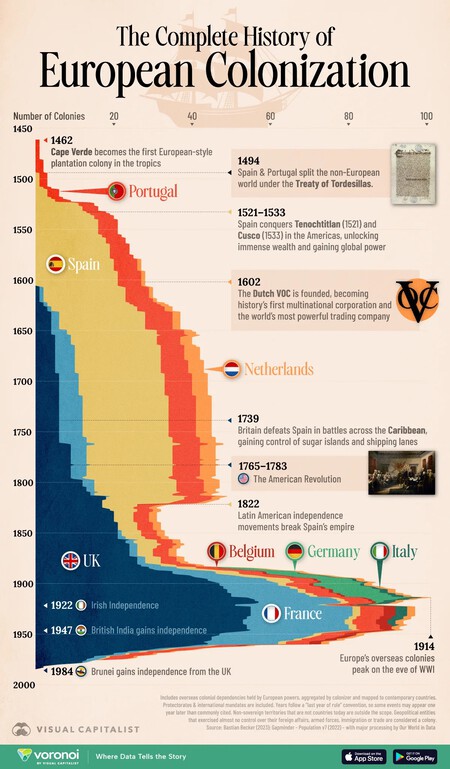
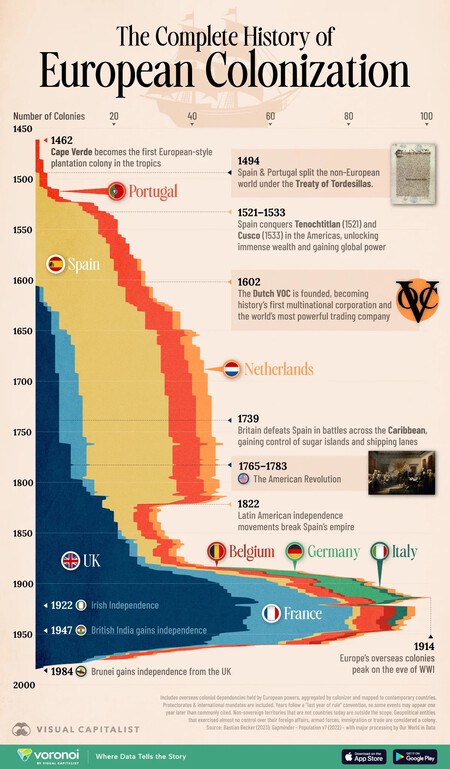
The project “Our World in Data,” associated with Oxford University, offers comprehensive visualizations of historical data on colonialism. Two notable infographics—available here and here—illustrate the rise and decline of various European empires. These graphics not only present data but encapsulate the processes of colonial expansion and decolonization, offering an enlightening overview of 550 years of colonial history.
Visual Capitalist. Data from Our World in Data – Colonialism
Portugal: The First Colonial Empire
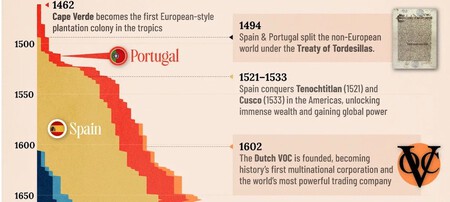
The Portuguese empire, spanning from 1415 to 1999, initially sought to access valuable resources such as gold and spices. Significant milestones, including Bartolomeu Dias rounding the Cape of Good Hope in 1488 and Vasco da Gama reaching India in 1498, cemented Portugal’s role as a frontrunner in global colonization. Through a network of coastal enclaves and larger territorial colonies like Brazil, Angola, and Mozambique, Portugal laid the groundwork for European colonial expansion.
Visual Capitalist. Data from Our World in Data – Colonialism
Spain: The Empire Where the Sun Never Sets
Spain’s colonial ambitions surged after the unification of Castile and Aragon, leading to a vast empire from 1492 until colonial dominance waned in 1976. The Spanish rapidly overthrew indigenous empires, such as the Aztecs and Incas, using force, disease, and other means to establish control. By the 18th century, Spain managed an empire that covered 13.7 million square kilometers, vividly demonstrating its global governance and administrative challenges.
The Expansion of Other European Powers
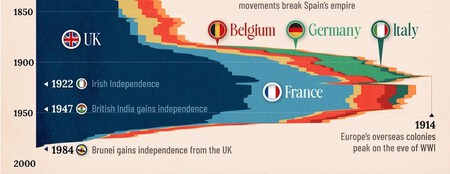
Colonial fervor peaked in 1914, with Europe controlling 101 colonies. Great Britain became a dominant force, primarily fueled by the Industrial Revolution, which provided them with the required resources and technologies for expansive colonization. Meanwhile, France focused on territories in Africa and Southeast Asia, while other nations like Belgium, Germany, and Italy snagged remaining territories, mainly in Africa. The Berlin Conference of 1885 exemplified this scramble, where powers divided Africa without regard for its indigenous people.
Visual Capitalist. Data from Our World in Data – Colonialism
The Dark Side of Colonialism
While the infographic presents impressive data, the reality of colonialism was often grim. According to the Dartmouth & Slavery Project, approximately 74% of the indigenous population in the Americas perished between 1492 and 1800 due to violence and diseases. In Africa, the consequences were similarly tragic, with 25 to 30 million people forcibly removed from their homes for slavery.
Colonialism not only inflicted immediate hardships but also sowed long-lasting seeds of racism, discrimination, and xenophobia. The Durban Declaration of 2001 highlighted these legacy issues that continue to affect contemporary societies.
The Russian Empire: A Unique Case
Unlike other colonial powers, Russia’s expansive empire tended towards land rather than sea, covering Siberia, Central Asia, and Eastern Europe. A study from Loyola University Chicago characterized Russia as “a colonial empire in denial,” acknowledging colonial practices predominantly in Asia.
The Twilight of Empires: Decolonization
The colonial framework began to unravel post-World War II, as economic and moral exhaustion led to independence movements gaining momentum. The Napoleonic Wars set the stage for decolonization in Iberian America, while the mid-20th century saw a wave of independence in Africa and Asia. Though many territories are no longer labeled as colonies, issues of self-determination remain relevant.
For a visual overview of European colonial history, see this infographic, which encapsulates the depth and complexity of over 550 years of colonialism.