
Trump’s Order for Smithsonian Museum Signage: A Controversial Development
Overview of the Executive Order
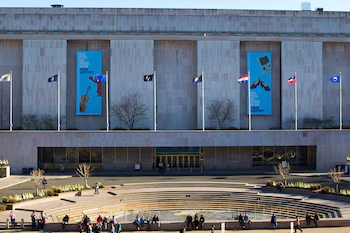
President Donald Trump recently mandated the installation of temporary signage at the National Museum of American History within the Smithsonian Institution. This directive is aimed at alerting visitors to what the administration describes as “inaccurate information” in some of the museum’s exhibits. The decision, outlined in a 162-page White House report released on July 4, claims that the museum does not present American history in a manner that is “honest” or “worthy” of the nation.
Key Points:
- The signs will be placed at the museum’s entrances and outdoor areas, given that the White House cannot directly alter the exhibits themselves.
- The administration seeks to create a temporary exhibit to highlight what it considers accurate portrayals of American history.
Justifications Behind the Report
The report, titled Saving American History, contends that the museum fails to recognize American history as a shared national legacy and instead uses its platform to promote “social justice” narratives. In essence, it criticizes the museum for allegedly transforming history into a tool for radical societal change.
Proposed Warning Notices
According to reports, the White House recommends explicit notices at each entry point, stating:
“Warning: This museum’s exhibits were put together by people who don’t want you to love your country.”
Such messaging has stirred considerable debate regarding its implications for educational integrity and national pride.
Institutional Responses
The Smithsonian, governed by an oversight structure that includes its own Board of Regents, has refuted the claims in the White House report. Anthea M. Hartig, director of the National Museum of American History, labeled the report as misrepresentative of the museum’s efforts. She argued that while improvements are always welcome, the museum’s work is deeply rooted in historical accuracy and the presentation of a complete narrative of American history.
Defense from Smithsonian Leadership
Lonnie Bunch, the Secretary of the Smithsonian, echoed Hartig’s sentiments, asserting that the museum’s commitment to presenting history is based on “erudition, precision, and unwavering commitment.” Both leaders maintain that the accusations put forth in the report fail to fairly assess the museum’s extensive efforts to educate the public effectively.
Long-term Implications
This directive marks a continuation of Trump’s broader campaign to reshape cultural institutions. Previously, he signed an executive order aimed at restricting federal funding for programs seen as promoting “divisive narratives.” This recent move raises questions about the intersection of politics and education in museums and other cultural establishments.
Previous Actions by the Trump Administration
Trump has engaged in a series of contentious actions concerning historical representations, including:
- Seeking changes at the John F. Kennedy Center for the Performing Arts to reflect what he considers appropriate programming.
- Advocating for revisions to interpretive panels at the George Washington house, arguing against what critics label as a “whitewashing” of slavery history.
Conclusion
The installation of signage at the Smithsonian Museum is a pivotal moment in the ongoing dialogue about how history is curated, presented, and interpreted in America. As the administration asserts its influence over cultural narratives, the effectiveness and public reception of such measures remain to be seen. The ensuing discussions not only touch upon historical accuracy but also the essence of national identity and memory-making in American society.